
The Federal Acquisition Regulation (FAR) is undergoing significant revisions designed to streamline procurement processes and enhance efficiency within federal agencies. Recent Executive actions, including Executive Order 14275, “Restoring Common Sense to Federal Procurement,” have set the stage for a comprehensive overhaul of the Government’s acquisition system, with particular emphasis on the U.S. Department of Defense.
Our Decoding the FAR Overhaul site is tracking the “Revolutionary” FAR Overhaul and provides timely information on the overhaul process and the revised FAR Parts as they are posted to the Government’s FAR Overhaul website, ensuring that you are well-positioned to navigate the evolving regulatory landscape for federal acquisitions. Our Government Contracts Practice stands ready to advise contractors on the implications of the FAR Overhaul, how to learn about and adapt to the changing rules, and how to make their voices heard.
Updated January 7, 2026
The Office of Federal Procurement Policy (OFPP) is conducting a crowdsourcing campaign to obtain feedback on the FAR overhaul in advance of formal notice and comment rulemaking. Those interested in participating will need to register on the site and then can submit ideas. The site asks for a short title for the idea, choosing a category that best describes the idea (start a practice; stop a practice; continue a practice; adjust or refine a practice; scale a practice; or other), a narrative description of the idea, and asks follow-on questions like why the practice should change and the operational impact. The site identifies categories of the “most helpful ideas” and those that should be avoided. The crowdsourcing campaign is ongoing until January 12, 2026 and provides industry a new opportunity to weigh in on the FAR overhaul prior to formal rulemaking.
Click a link to jump to one of the sections below:
Executive Order 14275
The FAR Overhaul
FAR Overhaul Approach
Strategic Acquisition Guidance
Version 2 of the FAR Companion Guide
Summary of Overhauled FAR Parts
FAR Part 1 (Federal Acquisition Regulations System)
FAR Part 2 (FAR Part 2 definitions were to be overhauled as individual parts were overhauled. On October 28, 2025, the FAR Council posted a full version of Part 2 along with a Practitioner Album, which states that this Part “will not be deviated in whole prior to rulemaking”)
FAR Part 3 (Improper Business Practices and Personal Conflicts of Interest)
FAR Part 4 (Administrative and Information Matters)
FAR Part 5 (Publicizing Contract Actions)
FAR Part 6 (Competition Requirements)
FAR Part 7 (Acquisition Planning)
FAR Part 8 (Required Source of Supplies and Services), FAR Part 51 (Use Of Government Sources By Contractors), and GSAM Part 538 (Federal Supply Schedule Ordering Procedures)
FAR Part 9 (Contractor Qualifications)
FAR Part 10 (Market Research)
FAR Part 11 (Describing Agency Needs)
FAR Part 12 (Acquisition of Commercial Products and Commercial Services)
FAR Part 13 (Simplified Procedures for Noncommercial Acquisitions)
FAR Part 14 (Sealed Bidding)
FAR Part 15 (Contracting by Negotiation)
FAR Part 16 (Types of Contracts)
FAR Part 17 (Special Contracting Methods)
FAR Part 18 (Emergency Services)
FAR Part 19 (Small Business)
FAR Part 20 (Reserved in the original and overhauled FAR)
FAR Part 21 (Reserved in the original and overhauled FAR)
FAR Part 22 (Application of Labor Laws to Government Acquisitions)
FAR Part 23 (Sustainable Acquisition, Material Safety, and Pollution Prevention)
FAR Part 24 (Protection of Privacy and Freedom of Information)
FAR Part 25 (Foreign Acquisition)
FAR Part 26 (Other Socioeconomic Programs)
FAR Part 27 (Patents, Data, and Copyrights)
FAR Part 28 (Bonds and Insurance)
FAR Part 29 (Taxes)
FAR Part 30 (Cost Accounting Standards Administration)
FAR Part 31 (Contract Cost Principles and Procedures)
FAR Part 32 (Contract Financing)
FAR Part 33 (Protests, Disputes, and Appeals)
FAR Part 34 (Major System Acquisition)
FAR Part 35 (Research and Development Contracting)
FAR Part 36 (Construction and Architect-Engineer Contracts)
FAR Part 37 (Service Contracting)
FAR Part 38 (Reserved in the overhauled FAR and moved to GSAM/R part 538)
FAR Part 39 (Acquisition of Information and Communication Technology)
FAR Part 40 (Information Security and Supply Chain Security)
FAR Part 41 (Acquisition of Utility Services)
FAR Part 42 (Contract Administration and Audit Services)
FAR Part 43 (Contract Modifications)
FAR Part 44 (Subcontracting Policies and Procedures)
FAR Part 45 (Government Property)
FAR Part 46 (Quality Assurance)
FAR Part 47 (Transportation)
FAR Part 48 (Value Engineering)
FAR Part 49 (Termination of Contracts)
FAR Part 50 (Extraordinary Contractual Actions and SAFETY Act)
FAR Part 51 (reserved in the overhauled FAR; prior content combined into FAR Part 8)
FAR Part 52 (FAR Part 52 clauses were overhauled as individual parts were overhauled. On October 28, 2025, the FAR Council posted an update to the overhauled clauses with full HTML viewing for easier navigation. The Practitioner Album includes a matrix that shows the clauses deleted, updated, and retained without change)
FAR Part 53 (Forms)
On April 15, 2025, President Trump issued Executive Order 14275, “Restoring Common Sense to Federal Procurement,” initiating the most comprehensive overhaul of the Federal Acquisition Regulation (FAR) since its inception over 40 years ago. The Order identifies the current FAR as “an excessive and overcomplicated regulatory framework” that has resulted in “an onerous bureaucracy” and aims to transform it into a streamlined set of essential regulations. EO 14275 establishes a policy direction “to create the most agile, effective, and efficient procurement system possible” by directing that the FAR should contain “only provisions required by statute or essential to sound procurement.” The Order builds upon several other Trump Administration Executive Orders focused on deregulation across federal agencies and improving federal procurements.
EO 14275 initiated a “revolutionary” overhaul of the FAR. The Office of Federal Procurement Policy (OFPP) and the FAR Council, with the General Services Administration, have established a dedicated landing page on Acquisition.gov called the “Revolutionary FAR Overhaul” (RFO) website. This site serves as the central repository for revised FAR Parts as they are completed and includes:
- Links to “Latest News & Announcements”
- A feedback mechanism for each revised FAR Part through which stakeholders can provide feedback. The FAR Council won’t respond separately to the feedback but is expected to use it in developing the final FAR rules.
- Access to revised FAR Parts and agency deviations
- “Line out” documents showing text removed from original FAR Parts (but, notably, not the text added or revised within the Parts)
- Links to OMB and FAR Council deviation implementation guidance
- Placeholders for future “Buying Guides”
- Frequently Asked Questions and Answers
Timeline: EO 14275 sets an aggressive timeline – requiring the OFPP Administrator to work with the FAR Council to amend the FAR within 180 days (by October 13, 2025). Agencies were required to designate senior acquisition officials by April 30, 2025, and to identify FAR provisions inconsistent with the Order’s policy objectives.
Phased Implementation and a “Caveat”: The initiative employs a two-phase approach:
- Immediate Implementation Through Class Deviations: The FAR Council issues model FAR deviation text on a rolling basis by FAR Part. Agencies are generally directed to issue agency-specific class deviations within 30 days of model text publication on the RFO website. The FAR Council also issued deviation guidance for agencies to follow.
- Formal Rulemaking: Following issuance of all revised FAR Parts, the FAR Council will undertake formal rulemaking through the notice and comment process as required by 41 U.S.C. § 1707.
With the upload of revised FAR Part 10, the RFO website now also includes a “caveat” that the FAR Council-created deviations include clauses and provisions currently required by statute and Executive Order, but that OMB and the FAR Council will recommend statutory changes to Congress and suggest to the White House rescission of requirements stemming from Executive Orders that are inconsistent with the goals of Executive Order 14275 “to stop the inefficient use of American taxpayer dollars in federal procurement.” Any changes as a result of changes to Executive Orders or statutes will be reflected during the formal rulemaking process.
Strategic Acquisition Guidance
A key element of the RFO is moving non-statutory buying strategies out of the FAR and into OFPP-endorsed “buying guides.” These guides, together with the streamlined FAR, will be known as the Strategic Acquisition Guidance (SAG). According to GSA, the first buying guide will focus on Software-as-a-Service (SaaS) acquisitions, reflecting the Administration’s emphasis on modernizing technology procurement.
Version 2 of the FAR Companion Guide
On September 9, 2025, the FAR Council posted the first version of the FAR Companion Guide, which has been referenced throughout the FAR Overhaul process. Version 1 covered the overhauled parts released through September 9, but “reserved” guidance on Parts 28, 29, 31, 34, 38, 43, 46, and 51. On October 30, 2025, the FAR Council posted the second version of the FAR Companion Guide. Version 2.0 adds FAR Companion (FC) parts 2, 3, 7, 13, 14, 15, 16, 17, 19, 20, 21, 22, 23, 24, 25, 27, 30, 32, 37, 41, 42, 44, 45, 47, 48, 52, and 53. Additionally, it updated FC parts 8.104, 11.102, 11.204, 12.001, and 12.301, and deleted FC Part 39.103.
The Guide tracks the FAR Parts and has a numbered citation preceded by “FC” that follows the citation conventions of the FAR (e.g., FC5.000, discussed below, tracks to FAR Part 5).
Below we summarize the Guide’s guidance for each Part.
For specific Companion Guide updates by Part, use the following links to navigate:
FAR Part 1 Companion Guide v.2 (Federal Acquisition Regulations System)
FAR Part 2 Companion Guide v.2 (Definitions)
FAR Part 3 Companion Guide v.2 (No additional guidance provided)
FAR Part 4 Companion Guide v.2 (Administration and Information Matters)
FAR Part 5 Companion Guide v.2 (Publicizing Contract Actions)
FAR Part 6 Companion Guide v.2 (Competition Requirements)
FAR Part 7 Companion Guide v.2 (Acquisition Planning)
FAR Part 8 Companion Guide v.2 (Required Sources of Supplies and Services)
FAR Part 9 Companion Guide v.2 (Contractor Qualifications)
FAR Part 10 Companion Guide v.2 (Market Research)
FAR Part 11 Companion Guide v.2 (Describing Agency Needs)
FAR Part 12 Companion Guide v.2 (Acquisition of Commercial Products and Commercial Services)
FAR Part 13 Companion Guide v.2 (No additional guidance)
FAR Part 14 Companion Guide v.2 (Sealed Bidding)
FAR Part 15 Companion Guide v.2 (Contracting by Negotiation)
FAR Part 16 Companion Guide v.2 (Types of Contracts)
FAR Part 17 Companion Guide v.2 (Special Contracting Methods)
FAR Part 18 Companion Guide v.2 (Emergency Acquisitions)
FAR Part 19 Companion Guide v.2 (Small Business)
FAR Part 20 Companion Guide v.2 (Reserved in the original and overhauled FAR)
FAR Part 21 Companion Guide v.2 (Reserved in the original and overhauled FAR)
FAR Part 22 Companion Guide v.2 (Application of Labor Laws to Government Acquisitions)
FAR Part 23 Companion Guide v.2 (Sustainable Acquisition, Material Safety, and Pollution Prevention)
FAR Part 24 Companion Guide v.2 (Protection of Privacy and Freedom of Information)
FAR Part 25 Companion Guide v.2 (Foreign Acquisition)
FAR Part 26 Companion Guide v.2 (Other Socioeconomic Programs)
FAR Part 27 Companion Guide v.2 (Patents, Data, and Copyrights)
FAR Part 28 Companion Guide v.2 (No additional guidance)
FAR Part 29 Companion Guide v.2 (No additional guidance)
FAR Part 30 Companion Guide v.2 (Cost Accounting Standards (CAS) Administration)
FAR Part 31 Companion Guide v.2 (No additional guidance)
FAR Part 32 Companion Guide v.2 (Contracting Financing)
FAR Part 33 Companion Guide v.2 (Protests, Disputes, and Appeals)
FAR Part 34 Companion Guide v.2 (No additional guidance)
FAR Part 35 Companion Guide v.2 (Research and Development Contracting)
FAR Part 36 Companion Guide v.2 (Construction and Architect-Engineer Contracts)
FAR Part 37 Companion Guide v.2 (Service Contracting)
FAR Part 38 Companion Guide v.2 (Reserved in the overhauled FAR and moved to GSAM/R part 538)
FAR Part 39 Companion Guide v.2 (Acquisition of Information and Communication Technology)
FAR Part 40 Companion Guide v.2 (Information Security and Supply Chain Security)
FAR Part 41 Companion Guide v.2 (Acquisition of Utility Services)
FAR Part 42 Companion Guide v.2 (Contract Administration and Audit Services)
FAR Part 43 Companion Guide v.2 (No additional guidance)
FAR Part 44 Companion Guide v.2 (Subcontracting Policies and Procedures)
FAR Part 45 Companion Guide v.2 (Government Property)
FAR Part 46 Companion Guide v.2 (No additional guidance)
FAR Part 47 Companion Guide v.2 (Transportation)
FAR Part 48 Companion Guide v.2 (Value Engineering)
FAR Part 49 Companion Guide v.2 (Termination of Contracts)
FAR Part 50 Companion Guide v.2 (Extraordinary Contractual Actions and the SAFETY Act)
FAR Part 51 Companion Guide v.2 (reserved in the overhauled FAR; prior content combined into FAR Part 8)
FAR Part 52 Companion Guide v.2 (Solicitation Provisions and Contract Clauses)
FAR Part 53 Companion Guide v.2 (No additional guidance)
- The RFO initiative represents the most significant transformation of federal procurement regulations in over four decades.
- The initiative provides a unique opportunity for contractors to provide feedback on the entirety of the FAR during both the deviation phase and formal rulemaking.
- Implementation through class deviations creates near-term uncertainty regarding which provisions apply to current and upcoming procurements.
- Contractors should prepare for potential contractual variability but may benefit from reduced administrative burdens in the long term.
- The initiative aims to better align federal procurement with commercial practices, potentially attracting new vendors to the federal marketplace.
Summary of Overhauled FAR Parts
FAR Part 1 (Federal Acquisition Regulations System)
- Revised Guiding Principles: Emphasizes efficiency and empowers the acquisition workforce. For example, one new principle is that “the contracting officer must have the authority, to the maximum extent practicable and consistent with law, to determine how and when to apply rules, regulations, and policies on a specific contract.”
- Workforce Empowerment: Revised Part 1 counsels that “acquisition team members may assume that if a specific strategy, practice, policy, or procedure is in the best interests of the Government and is not addressed in the FAR, nor prohibited by law (statute or case law), Executive Order or other regulation, then they are allowed to use the strategy, practice, policy, or procedure.”
- Sunset Provision: Establishes a four-year expiration date for all non-statutory FAR provisions unless renewed by the FAR Council.
- Streamlined Class Deviation Process: Simplified provisions for agency heads to authorize class deviations with removal of prior NASA and DOD-specific terms and exceptions.
- Revised Public Participation Terms: FAR Subpart 1.5’s provisions were replaced with a single sentence referencing 41 U.S.C. § 1707.
- Minor Changes to Former FAR Subparts 1.6 and 1.7: New Subpart 1.4 (Career Development, Contracting Authorities, and Responsibilities) and new Subpart 1.5 (Determinations and Findings) are similar to former Subparts 1.6 and 1.7.
FAR Overhaul Companion Guide v.2 (Part 1): FAR Part 1 of the Guide encourages collecting voluntary feedback to support “continuous learning, better results, and improved outcomes. . . .” That feedback can be used broadly, from the acquisition team alone to the entire Government “to enhance the acquisition system.” Reflecting a recurring theme in the overhauled FAR, acquisition teams are encouraged to communicate with industry throughout the acquisition lifecycle, and an emphasis is placed on fairness and impartiality. It notes that “fairness does not necessarily mean identical treatment.”
FAR Part 2 (FAR Part 2 definitions were to be overhauled as individual parts were overhauled. On October 28, 2025, the FAR Council posted a full version of Part 2 along with a Practitioner Album, which states that this Part “will not be deviated in whole prior to rulemaking”)
FAR Overhaul Companion Guide v.2 (Part 2): This part of the Guide is straightforward and identifies those definitions changed, those removed, and those moved in the Overhaul.
FAR Part 3 (Improper Business Practices and Personal Conflicts of Interest)
The overhaul of FAR Part 3 is primarily addressed to plain-language updates as opposed to reorganization and massive streamlining. This is largely because the Part implements numerous statutes, including the Procurement Integrity Act, personal financial interests in 18 U.S.C. § 207, the Anti-Kickback Act, antitrust considerations, and laws that protect whistleblowers, prohibit confidentiality agreements, and require disclosure to the Government, among other statutes. The structure of the Part remains the same, and all implementing clauses are unchanged except that FAR 52.203-15, Whistleblower Protections under the American Recovery and Reinvestment Act of 2009, has been deleted as outdated and obsolete.
- Deleted Provisions: A handful of rules were deleted from the Part: FAR 3.103-3, regarding additional certifications of independent pricing, is removed because “it is a discretionary instruction," according to the Practitioner Album; FAR 3.301, relating to antitrust violations, is removed as it is general guidance and summary; FAR 3.406, relating to records of violations of the prohibitions on contingent fees in Subpart 3.4, is deleted as redundant; FAR 3.907 and its associated clause, FAR 52.203-15, are removed as obsolete, for the reasons discussed above; and most of FAR 3.700, about voiding or rescinding contracts if there is a conviction of bribery, is deleted (similar text appears in the immediate following provision, FAR 3.701).
- Slight Tweak Relating to Contractor Disclosure Obligation: FAR 52.203-13 includes the requirement that principals of contractors timely disclose credible evidence of civil False Claims Act and certain criminal violations to agency Offices of Inspector General. Old FAR 3.1003(2) stated that regardless of whether the clause exists in a contract, a contractor could be suspended or debarred if the principal failed to make such a mandatory disclosure. The updated provision states this point more directly: “This disclosure requirement applies whether or not clause 52.203-13 is applicable.”
- Practitioner Album with Links to Defense Acquisition University (DAU) Training and Case Study: The Practitioner Album might be the most interesting aspect of the overhaul of this Part. It includes a high-level, easy to comprehend graphic of the “fundamental rules of ethical conduct”:
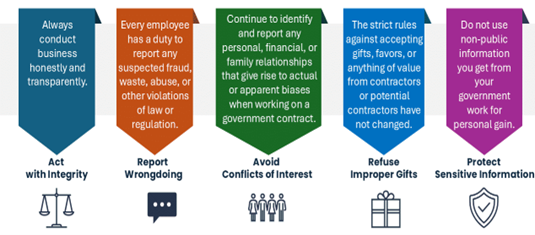
It also includes several DAU resources that contractors may also find useful, including a Procurement Integrity “Summer Law Series” video, slides on navigating conflicts of interest, and a webinar on procurement integrity, collusion, and disclosures.
In addition to these resources, the Album includes a case study based on the U.S. Government Accountability Office (GAO) decision in Teledyne Brown Eng’g, Inc., B-418835, Sept. 25, 2020, which we wrote about here. Among other things, the protester in that procurement alleged that certain NASA employees had conflicts of interest relating to the protested procurement. These conflicts arose from an ongoing personal relationship between a current NASA employee, who had a leadership role in the procurement, including the evaluation of proposals, and an executive of one of the major subcontractors of the awardee. This relationship included weekly social gatherings – and competitive foosball – with other contractor employees connected to the procurement. Although the NASA employee disclosed the relationship to others in the agency, the apparent conflict was not adequately addressed, leading GAO to sustain the protest, recommend termination of the awarded contract, and recommend that NASA begin the competition anew. The case study concludes with an “Agency Lesson Learned”: “As a result of this protest, many NASA centers have updated ethics and source selection training, and have elected to publish the names of source selection members to help mitigate and identify any potential personal conflict issues before receipt of proposals.”
FAR Overhaul Companion Guide v.2 (Part 3): The Guide provides no additional guidance for this part.
FAR Part 4 (Administrative and Information Matters)
Overhauled FAR Part 4 is chiefly a restructuring to align each subpart with the stages of an acquisition, simplifying it down to just four subparts to make it a quicker reference for contracting officers: (1) Presolicitation; (2) Solicitation, Evaluation, and Award; (3) Post-award; and (4) Contractor Records Retention. Greater emphasis is placed on e-commerce “to the maximum extent practicable” per 41 U.S.C. § 2301, and for contracting officers to keep comprehensive documentation for both transparency and litigation support. It incorporates some definitions from current FAR 52.204-10, Reporting Executive Compensation and First-Tier Subcontract Awards for relevant provisions, including “Executive” and “First-Tier Subcontract.”
- Substantial Streamlining: Overhauled FAR Part 4 has been reduced by approximately 50% in word count, focusing on a plain-language rewrite and reorganization. Obsolete administrative tasks, such as procedures for paper copies of contract files, have been eliminated.
- Consolidation of SAM.gov Requirements: The overhaul consolidates provisions related to contractor registration and identification in the System for Award Management (SAM.gov), including consolidating six contract clauses (e.g., Taxpayer IDs, UEIs, and CAGE codes) down to two: an updated FAR 52.204-7, SAM Management – Registration and FAR 52.204-90, Offeror Identification. As part of this consolidation, GSA will remove many representations and certifications from SAM.gov, and these will be made at the contract level. For example, entity-level representations and certifications (e.g., small business and responsibility) will remain in SAM.gov, but others (e.g., independent price determination, place of performance, Buy American and Trade Agreements Act compliance, and so on) will be removed. Many contractors already elect the options not to make such representations and certifications in their SAM registrations.
- Content Eliminated: The overhauled FAR Part 4 moves all security-related matters to the overhauled FAR Part 40. Detailed practices for maintaining the contract file have been moved to the FAR Companion Guide. Government reporting on service contracts has been eliminated for commercial services contracts.
- Content Retained: The overhauled version retains policies for the use of unique Procurement Instrument Identifiers (PIID) and the use of consistent CLIN structures, and to expressly allow for digital signatures. It also retains statutory administrative requirements such as:
- Information Concerning Transactions With Other Persons (26 U.S.C. §§ 6041 et seq.)
- Identifying Numbers (26 U.S.C. § 6109)
- Using Procurement Contracts (31 U.S.C. § 6303)
- Taxpayer Identifying Number (31 U.S.C. § 7701)
- Functions, Federal Procurement Data System (41 U.S.C. § 1122)
- Record Requirements (41 U.S.C. § 1712)
- Use of Electronic Commerce in Federal Procurement (41 U.S.C. § 2301)
- Examination of Facilities and Records of Contractor (41 U.S.C. § 4706)
- Federal Funding Accountability and Transparency Act of 2006 (Pub. L. 109-282)
- Digital Accountability and Transparency Act of 2014 (Pub. L. 113-101)
- Practitioner Album focuses on making it easier to find needed information at each stage of the procurement process: The overhauled FAR Part 4 Practitioner Album explains that “[t]his part has been reorganized within each subpart to follow the acquisition process (i.e., steps to take before solicitation versus after award). This new structure makes it easier and faster to find needed information at each stage of a procurement. A significant amount of content is also relocated to FAR part 40 to better align with security requirements.”
FAR Overhaul Companion Guide v.2 (Part 4): Part 4 of the Guide discusses how contract files are organized across the acquisition workforce. The contracting office maintains the most comprehensive file capturing the full planning, evaluation, and award record. The contract administration office keeps documents tied to postaward administration and performance oversight. The paying office will maintain documentation related to payments and financial records for the contract. Finally, this part emphasizes using streamlined processes to close out low-risk contracts in an efficient manner.
FAR Part 5 (Publicizing Contract Actions)
- Reorganization: As part of the FAR Council’s general approach to the overhaul, FAR Part 5 has been revised to be in order of the acquisition lifecycle, rather than topic-based, when discussing the information that agencies must publicize pre- and post-award.
- Previous FAR Subparts 5.1 and 5.2 were re-titled Presolicitation and Solicitation.
- Throughout the Part, requirements were re-ordered so that the first three of each Subpart begins with general requirements, followed by specialized requirements and exceptions.
- Several tables replace the use of longer, written direction. For example, two tables are used in FAR 5.101 to identify applicable dollar thresholds that trigger different agency requirements. Another table was added to FAR 5.301 titled “Minimum Timeframes for Posting Award Notices.”
- Plain Language: Through this Part, the terms “synopsis,” “will” and “would” (when preceding a verb), and prepositional phrases were removed in favor of more active verbs.
- The overhauled FAR Part 5 has an increased use of acronyms (e.g., GPE = Governmentwide point of entry)
- Where specific requirements may have been nested in romanettes following a broader requirement, some language was rewritten as generalized statements. For example, the text “a qualification requirement” generally replaced lists of more specific requirements, as in: “State whether an offeror or its product or service must meet a qualification requirement in order to be eligible for award; and if so, identify the office from which the qualification requirement may be obtained.”
- Content Moved: There are two references to content moved to another FAR Part. First, the lineout states that public disclosure requirements for limited-source justifications for Federal Supply Schedule orders or blanket purchase agreements over the simplified acquisition threshold (SAT) will be moved to FAR Part 8. Second, the lineout indicates that public disclosure requirements for task or delivery order justifications over the SAT made without fair opportunity will be moved to FAR Part 16.
- Content Eliminated: Requirements relating to three Subparts was removed:
- Subpart 5.4 Release of Information. This Subpart previously included permissive statements about the type of information Contracting Officers (CO) could release to the public and procedures for releasing information to members of Congress.
- Subpart 5.6 Publicizing Multi-Agency Use Contracts. This Subpart previously required agencies to enter information into a specific governmentwide contracts database and was removed as outdated and duplicative of the requirements in revised Subparts.
- Subpart 5.7 Publicizing Requirements Under the American Recovery and Reinvestment Act of 2009 (ARRA). This Subpart prescribed posting requirements for presolicitation and award notices for actions funded by the ARRA. This section was struck from the overhaul on the basis that the statute is no longer in effect.
- Practitioner Album: This album is slim, with a short summary of the changes and the typical “lineout” document showing text removed from FAR Part 5, but not the added text. The “smart accelerators” section is focused on recommendations largely targeting agency personnel who would be responsible for publicizing various contract actions and reflects the Administration’s efforts to reach nontraditional contractors. For example, the smart accelerators recommend that agency personnel consider cross-posting various announcements “to digital platforms like interactive online portals and social media” and encourage early posting of acquisition forecasts and notices.
FAR Overhaul Companion Guide v.2 (Part 5): This part of the Guide emphasizes the need for plain language in solicitations and discourages technical jargon, complex sentence structures, and acronyms not widely understood. The Guide instructs that presolicitation notices must be concise and include only necessary details. Beyond SAM.gov, the Guide encourages use of industry-specific websites, social media, interactive portals, mobile tools, virtual industry days, online forms, and webinars to expand outreach, especially to small and emerging vendors. SAM.gov should be utilized not just for postings but also for market research and feedback. For product-specific acquisitions, notices should list key specifications and set response times that reflect both complexity and urgency. This part also notes that even if statutes refer to paid advertisements for market research and outreach, the Guide favors using digital outreach.
FAR Part 6 (Competition Requirements)
At first glance, the revisions to FAR Part 6 appear dramatic as large swaths of text have been eliminated. Upon closer examination, however, the changes are not generally substantive. Rather, the part has been revised to be much more concise and use plainer language. Here is our take on the highlights of the revisions.
- Substantial Streamlining: The overhauled FAR Part 6 has been reduced from five subparts to three. The number of sections has been reduced from over 30 to under 20, representing a significant streamlining effort. The reorganized subpart structure is:
- Subpart 6.1 is renamed from “Full and Open Competition” to “Presolicitation.” This subpart includes the policy for full and open competition, full and open competition after excluding sources, other than full and open competition, and the justification and approval (J&A) requirements.
- Subpart 6.2 is “Reserved” (previously “Full and Open Competition After Exclusion of Sources”)
- Subpart 6.3 is renamed from “Other Than Full and Open Competition” to “Postaward” and now contains only the justification posting requirements.
- Original FAR Subpart 6.4, “Sealed Bidding and Competitive Proposals,” is now in overhauled FAR 6.101(b), and original FAR Subpart 6.5, Advocates for Competition, is now streamlined to two paragraphs in new FAR 6.003.
- Consolidated Set-Aside Provisions: All small business set-aside authorities previously detailed in separate sections (original FAR 6.203-6.208) have been consolidated into two sections:
- Overhauled FAR 6.102-2 now covers all small business set-asides, including Small Business Innovation Research and Small Business Technology Transfer (SBIR/STTR) programs and socioeconomic categories and refers to Part 19 for the details.
- Overhauled FAR 6.102-3 addresses set-asides for local firms during major disasters or emergencies and repeats the two categories of set-asides from 6.102-2 (SBIR/STTR and “specific small business socioeconomic categories”).
- Streamlined “Other Than Full and Open Competition” Authorities: The seven circumstances permitting other than full and open competition in FAR Subpart 6.3 (original FAR 6.302-1 through 6.302-7) have been renumbered and simplified (now 6.103-1 through 6.103-7), with clearer, more concise language, fewer prescriptive requirements, and removal of examples.
- Simplified Justification and Approval (J&A) Requirements:
- Justification content requirements (new FAR 6.104-1) have been streamlined but largely mirror original FAR 6.303-2 content requirements.
- Approval thresholds (new FAR 6.104-2) are now presented in a table format with four tiers: $750,000 or below (contracting officer); >$750,000-$15 million (M) (advocate for competition); >$15M-$75M (or $100M for DoD/NASA/Coast Guard) (head of procuring activity); and above $75M (or $100M for DoD/NASA/Coast Guard) (senior procurement executive).
- The requirement to post justifications publicly within specified time frames remains substantively the same, though reorganized into a cleaner format in new Section 6.301.
- Other Retained and Simplified Provisions: The overhauled part maintains the one-year limitation for contracts awarded under unusual and compelling urgency (6.103-2) but simplifies the documentation requirements and clarifies that exceptional circumstances determinations are separate from the J&A. The revised part distinguishes between brand-name descriptions (which preclude competition) and “brand-name or equal” descriptions (which provide for full and open competition), with clearer guidance on when justifications are required and a helpful example in FAR 6.103-5, “Authorized or required by statute,” of when an agency may have a need for a “brand-name commercial product for authorized resale (e.g., commercial products for resale through commissaries).”
- Practitioner Album Focused on Competition: The overhauled FAR Part 6 Practitioner Album explains that the streamlining of the part is intended to “strengthen clarity and focus, ensuring procedures that support full and open competition are easier to understand and apply.” It notes that contracting officers retain discretion to set aside contracts for small businesses but removes the “prescriptions around socioeconomic concerns.” It includes the usual line out document (that does not show “line ins”) and “Smart Accelerators.” Here, there are several useful modules on enhancing competition through early acquisition planning, the importance of crafting a “strong” J&A with a “practitioner’s tip” that includes “do’s and don’ts.” One such tip is to “prioritize mission priorities over legal technicalities” and to recognize that urgent and compelling circumstances are not limited to wartime, but include “delay [that] may result in serious injury, financial or otherwise to the government or other parties.” Another module addresses maximizing competition throughout the contract lifecycle by using “on/off ramping.” This module encourages acquisition professionals to build in on/off ramping to address changed market conditions (new providers or new products/services), particularly for multi-year IDIQ contracts and blanket purchase agreements. The module explains how to implement on/off ramping, the strategic impact (keeping the contract competitive by adding new vendors and removing under-performers and avoiding the need to initiate a new procurement as a result of market changes), and refers acquisition professionals to GSA’s Acquisition Gateway, an online platform for government acquisition programs, policies, initiatives and tools, for success stories and more information.
FAR Overhaul Companion Guide v.2 (Part 6): Part 6 of the Companion Guide emphasizes that competition and innovation depend on robust early acquisition planning. It encourages structuring requirements to open the field, including breaking large needs into smaller, more competitive packages, exploring commercial solutions before custom development, and using evaluation criteria that reward better approaches. It calls for early identification and mitigation of barriers such as incumbent advantage or unnecessarily unique requirements to broaden the potential vendor base. When exceptions to competition are necessary, they must reflect genuine market conditions rather than poor planning. Justification and Approval (J&A) documents must clearly explain the rationale, show thorough market research, and align the cited authority with the facts of the acquisition.
FAR Part 7 (Acquisition Planning)
The overhauled FAR Part 7 includes plain-language edits and heavily streamlined provisions. Minor changes to terminology in several sections accompany the removal of several others that are addressed in the clauses in FAR Part 52. The accompanying Practitioner Album stresses that Part 7 “is not an isolated part, but is rather intertwined with all other FAR elements.”
- Streamlined: Updates include plain-language revisions (e.g., “must” replaces “shall” and “telework” replaces “telecommuting”) and deleting provisions with similar content to clauses in FAR Part 52. Agency head responsibilities were rewritten from specific tasks to high-level mandates, including creating agency-specific procedures for acquisition planning. It is unclear if those agency procedures will be incorporated into supplements to the FAR or other agency guidance. “Relevant content” related to written acquisition plans will also be provided in the FAR Companion Guide.
- Acquisition Planning: New FAR 7.102 Requirements, no longer requires written acquisition plans that include specific elements, as were required by former FAR 7.105. Acquisition planning is still required for all acquisitions, but acquisition plans may be written or oral depending on the type of acquisition. Cost reimbursement and “high-risk” contracts require written plans, while agencies may require written plans for firm-fixed-price contracts. All acquisition plans must promote acquisition of commercial products and services, full and open competition, selection of the appropriate contract type, and the use of existing contracts.
- FAR Part 10: Requirements for small business concerns regarding bundling and consolidation are imported from FAR Part 10 into new FAR 7.107.
- FAR Part 52: Information on Responsibility of Contracting Officers (FAR 52.207-4), Economic Purchase Quantity—Supplies (FAR 52.207-4), Option to Purchase Equipment (FAR 52.207-5), and Solicitation from Small Business (FAR 52.207-6) are retained without changes in FAR Part 52, and similar content has been removed from Part 7.
- Retained: Requirements retained include:
- Definitions in FAR 7.101, with clarifications and plain language updates
- Planning and Solicitation, 41 U.S.C. §§ 3301 et seq.
- Preference for Commercial Products and Commercial Services, 10 U.S.C. § 3453
- Consolidation of Contract Requirements, 15 U.S.C. § 657
- Awards or Contracts, 15 U.S.C. § 644
- Cost-Effectiveness Analysis of Equipment Rental, Pub. L. 115-254, Sec. 555
- Performance of Inherently Governmental and Critical Functions, OFPP Policy Letter 11-01
- Deleted: Provisions deleted as “outdated, redundant, or otherwise unnecessary” include:
- Subpart 7.3, Contractor Versus Government Performance, was deleted because “Congress has consistently placed a statutory hold on A-76 competitions since 2008.”
- FAR 7.200, Scope of Subpart, relating to economic quantities of purchases was deleted.
- GSA guidance in FAR 7.403 was deleted as “informational.”
- The clauses at FAR 52.207-1, Notice of Standard Competition, 52.207-2, Notice of Streamlined Competition, and 52.207-3, Right of First Refusal of Employment were deleted.
FAR Overhaul Companion Guide v.2 (Part 7): Part 7 of the Guide states that acquisition planning should begin as soon as a need is identified, rather than waiting for funding. The guidance describes a collaborative process in which stakeholders clarify requirements, assess market options, and set strategies that are intended to foster competition and innovation. It encourages the development of a clear needs statement and again emphasizes early engagement with industry, breaking requirements into parts, looking for commercial solutions, and designing acquisition approaches that favor innovation. Consistent with the FAR Overhaul, the Guide reiterates that early, fair communication with industry is appropriate and encouraged during planning, including one-on-one meetings when no vendor is favored. Acquisition plans, according to the Guide, should be treated as living documents that are updated as circumstances change and tailored to the complexity of the procurement. This flexible approach is meant to manage risk, support competition, and keep strategy aligned with changing circumstances.
FAR Part 8 (Required Source of Supplies and Services), FAR Part 51 (Use Of Government Sources By Contractors), and GSAM Part 538 (Federal Supply Schedule Ordering Procedures)
The most significant change in the overhauled Part 8 is the deletion of the ordering procedures for Federal Supply Schedule (FSS) contracts (i.e., GSA Schedules), which are being moved from FAR Subpart 8.4 to new Subpart 538.71 of the GSA Acquisition Manual (GSAM). In addition, the provisions in FAR Part 51 regarding use of government sources of supply by contractors have been moved to Part 8 and revised to expand the ability for contractors to use government sources of supply “when it is in the Government’s interest.” Another noteworthy change in overhauled Part 8 is that agencies must use an existing government-wide contract or blanket purchase agreement to buy the supply or service if the contract has been designated by the Office of Federal Procurement Policy as a “required use” contract, unless the head of the contracting activity provides an exception. These “required use” contracts have not yet been identified. Per the Practitioner Album, “if an existing ‘best-in-class’ contract (BIC) meets the new criteria, it will be designated as a ‘required use’ contract.” The overhaul also eliminates the restrictions on single-award blanket purchase agreements over $100 million and adds provisions encouraging “innovation” when placing orders and establishing FSS BPAs.
- Streamlined FSS Ordering Procedures: The FSS ordering procedures previously contained in Subpart 8.4 have been entirely removed from the FAR and moved to Subpart 538.71 of the GSAM. Some of the basic procedures previously contained in FAR 8.4 have been retained, including the requirement to use requests for quotations (RFQs), which the GSAM makes clear are not subject to the requirements in FAR Part 15 (including the requirement for debriefings, as well as the requirements for preparing evaluation plans, scoring quotations, or establishing a competitive range before communicating with quoters or soliciting revised quotations). However, the FSS ordering procedures in GSAM 538.71 have been significantly streamlined and simplified, to include:
- Elimination of separate ordering procedures for supplies and services requiring a statement of work;
- Elimination of the restrictions on single-award BPAs over $100 million;
- Elimination of the provisions regarding inclusion of “open market” items, which are instead addressed through the recently-added GSAM 538.72 provisions allowing the inclusion of non-Schedule products and services under the special item number (SIN) for “Order Level Materials”; and
- Encouragement for agencies to use “innovative RFQ approaches” when placing FSS orders and BPAs (including use of the techniques identified in the “Periodic Table of Acquisition Innovations” at https://acquisitiongateway.gov/periodic-table).
-
Emphasis on Use of Future “Required Use” Contracts and Existing Contracts or Blanket Purchase Agreements (BPAs): Consistent with recent Executive Orders, overhauled Part 8 requires agencies to use existing GWACs or BPAs for purchases of supplies or services but new FAR 8.104(a)(1) prioritizes “required use” contracts that will be identified by OFPP and mandates that agencies use these “required use” contracts unless the agency head of contracting activity provides an exception. If a “required use” contract is not available, agencies should then consider other existing GWACs or BPAs. Use of BICs will continue to be prioritized but will not be mandated, according to the Practitioner Album. Finally, agencies should consider whether shared services will fulfill their requirements.
- Expansion of Contractors’ Use of Government Sources of Supply: The provisions in FAR Part 51 and related clauses regarding contractor use of government sources of supply have been relocated in their entirety to FAR Subpart 8.105. While Part 51 previously limited the use of government sources of supply to cost-reimbursement contracts, overhauled Part 8 allows agencies to authorize any contractor to use a government source of supply “when it is in the Government’s interest.” In addition, the new FSS ordering procedures in GSAM Subpart 358.71 provide that GSA Schedule contractors “may acquire products, services, or solutions from other FSS contractors” in the performance of any FSS order or BPA.
- Mandatory Sources: Overhauled Part 8 retains the provisions on mandatory sources in previous FAR 8.000-8.005 and Subparts 8.6, 8.7, 8.8, and 8.9 (e.g., existing agency inventories, Federal Prison Industries, and the AbilityOne Program) and reorganizes them in new Subparts 8.1, 8.2, 8.3, and 8.5. The overhauled provisions include plain-language revisions, but the requirements to use those mandatory sources and the priority among them are substantively unchanged.
FAR Overhaul Companion Guide v.2 (Part 8): The Guide establishes sourcing priorities: agencies must first use excess personal property, then mandatory sources such as Federal Prison Industries (UNICOR) and the AbilityOne Program. If those are unavailable, FAR 8.104 requires procurement through Office of Federal Procurement Policy-designated “required use” governmentwide contracts or blanket purchase agreements (BPAs) unless the contracting activity head grants an exception. As of early December 2025, no “required use” contracts have been designated, so this requirement is forward-looking. If no suitable required use vehicle is available, agencies should turn to other governmentwide contracts or BPAs before creating a new contract. The Guide also introduces a beta Category Management Buying Guide, promotes streamlined ordering under Federal Supply Schedule contracts via the Periodic Table of Acquisition Innovations (PTAI), and encourages phased acquisitions. For exchanges with offerors, once the government identifies the most advantageous quotation, it may communicate only with that quoter to resolve remaining issues, mirroring proposed FAR Part 15 changes allowing additional negotiations with a single offeror after initial competitive-range negotiations, although bid protest forums have yet to weigh in on this proposed FAR rewrite. Finally, FAR 8.401(b) urges contracting officers (COs) to provide “brief explanations” promptly, ideally by including them in award notices in order to start the GAO protest clock immediately.
FAR Part 9 (Contractor Qualifications)
FAR Part 9 received a relatively light touch in the overhaul process, with the most changes occurring in Subpart 9.1. In addition, two Subparts are being moved to the FAR Companion Guide (Subparts 9.6 (Contractor Teaming Arrangements) and Subpart 9.7 (Defense Production Pools and Research and Development Pools)). Other changes include the standard elimination of “shall” in favor of “must,” use of the active verb tense and sentence format, and elimination of “wordiness.” FAR Subparts 9.4 (Debarment, Suspension, and Ineligibility) and 9.5 (Organizational Conflicts of Interest) received some of the lightest touches. This is welcome news, since the FAR Council just completed a major revision of Subpart 9.4 in January 2025, and the OCI rules are pending revision from a proposed rule also issued in January.
- Changes to FAR Subpart 9.1
- Policy statement at FAR 9.103 revised: The policy statement was revised to eliminate text in paragraph (c) that admonished contracting officers that giving awards to the lowest priced offeror may not be in the Government’s best interest if the contractor does not perform well.
- Special responsibility criteria removed. Guidance on special responsibility criteria for specific types of acquisitions has been removed. FAR 9.104-2 is now “reserved.”
- Standards for responsibility shortened: The standards a contracting officer applies to determine whether an offeror is responsible in 9.104-3 are retained, but both FAR 9.104-3(a), ability to obtain resources, and 9.104-3(b), satisfactory performance record, have been substantially shortened to remove examples. If this text is not provided in other sources, such as the Companion Guide, contracting officers and contractors may face frustration with either assessing responsibility or challenging a finding of nonresponsibility. For example, the qualifier of “seriously” deficient contract performance as an indicator of nonresponsibility has been removed from 9.104-3(b), as well as the guidance to consider the number of contracts or the extent of deficient performance. As revised, the provision states only: “Presume a prospective contractor is nonresponsible if it is or recently [has] been deficient in contract performance, unless the circumstances were beyond the contractor’s control, or the contractor has taken corrective action.” Without the qualifier of “seriously,” a definition of “deficient,” or examples of what types of deficiencies rise to the level of nonresponsibility, contractors could face a finding of being nonresponsible for relatively minor or single time “deficiencies” in performance. Given the impact of such a finding and the historical difficulty of challenging them, these changes may lead to unintended consequences.
- Text regarding “preaward surveys” and capability statements from AbilityOne nonprofits removed: FAR 9.105-1 removes guidance on and use of preaward surveys of responsibility, and FAR 9.106 regarding preaward surveys is eliminated with the provision marked as “reserved.” FAR 9.107, surveys of nonprofit agencies participating in the AbilityOne program, is also removed and reserved. Both are now being moved the FAR Companion Guide; the Practitioner Album summary of changes also notes that FAR Part 8 addresses the AbilityOne Program as well.
- Notable change to overhauled Subpart 9.3. Contractors may like the removal of the first sentence of FAR 9.305, which stated in the “old” FAR: “Before first article approval, the acquisition of materials or components, or commencement of production, is normally at the sole risk of the contractor.” As revised, the FAR 9.305(a) states somewhat more generously: “To minimize contractor risk, provide sufficient time in the delivery schedule for acquisition of materials and components as well as for production after receipt of first article approval.”
- Some examples retained: Many of the revisions to other FAR parts involve removing examples. Here, for instance, the examples in FAR 9.406-2(b)(1)(v) of when non-delinquent taxes become delinquent were removed. But the examples of types of OCIs in FAR 9.508 have been retained, which is helpful while, as noted above, the OCI rules are undergoing potential updates.
- Some typos introduced: Sometimes shorter is not always clearer, and sometimes words get added or dropped in the overhaul process (see new FAR 9.104-3(b), discussed above). There is also a typo in overhauled FAR 9.407-3(b) and a dropped reference to debarment in revised FAR 52.209-6(d)(4). The “Feedback” box is a handy way to forward these and other awkward revisions to the FAR Council.
- Two parts eliminated: As noted above, both Subpart 9.6 and 9.7 have been removed from the FAR and their content will be covered by the forthcoming FAR Companion Guide.
- Implementing FAR Part 52 Clauses Tweaked: Beyond changes to “must” vs. “shall,” subtle edits have been made to some of the FAR Part 52 clauses that implement FAR Part 9. For example, FAR 52.209-2, Prohibition on Contracting With Inverted Domestic Corporations – Representation, now repeats definitions that appear in both old and new FAR 52.209-10. The delinquent tax-related examples have been removed from FAR 52.209-5, consistent with their removal from FAR 9.406-2(b)(1)(v), and the admonition that the certifications within the clause may subject the maker to prosecution, if false or fraudulent, under 10 U.S.C. § 1001 has been deleted. FAR 52.209-11 implements a restriction from past appropriations laws that the Government cannot use appropriated funds for a contract with a contractor that has delinquent taxes or a felony conviction within the past 24 months unless a suspending and debarring official has considered the matter and determined that suspension or debarment is not necessary to protect the Government’s interests. The overhauled clause deletes the statutory basis and reference that the clause applies “if contained in subsequent appropriations acts.” FAR 52.209-13, Violation of Arms Control Treaties or Agreements – Certifications, deletes half of the certification under paragraph (b)(1) – subparagraph (b)(1)(ii) – regarding entities “owned or controlled by the offeror.” It is unclear if this deletion was intentional, since the clause retains the romanette for the first subparagraph of the clause.
FAR Overhaul Companion Guide v.2 (Part 9): Part 9 of the Companion Guide discusses contractor qualifications, describing how contractor team arrangements and defense production or research pools are recognized as ways to combine capabilities for government contracts, particularly in complex or specialized acquisitions. These are two issues that were removed from the FAR in the Overhaul. The guidance notes that awarding contracts solely on the basis of lowest price can result in unfavorable situations such as poor performance or additional costs. Accordingly, the Guide recommends using evaluation criteria that support best value. It also addresses the use of special standards of responsibility for acquisitions requiring unusual expertise, the selective use of pre-award surveys to assess contractor capability, and the Qualified Bidders List as a tool for recurring procurements to streamline processes and meet agency-specific requirements.
- Structure Simplified: FAR Part 10 originally contained four sections: 10.000 Scope of part, 10.001 Policy, 10.002 Procedures, and 10.003 Contract clause. The revised version eliminates the separate “Policy” and “Procedures” sections, combining essential elements into a more streamlined “Market research requirements” section.
- Content Eliminated: Several detailed provisions have been removed, including:
- Policy statements about ongoing market research for contingency operations, defense against attacks, and disaster relief.
- Procedures for conducting market research, including specific techniques and methods.
- References to querying the governmentwide database of contracts.
- Instructions about reviewing systems like the System for Award Management (SAM) and Federal Procurement Data System (FPDS).
- Guidance on customary commercial practices and buyer financing.
- Requirements for consideration of sustainable products and services.
- Specific references to considering consolidation and bundling deemed redundant to FAR Part 7.
- Requirements related to consulting with small business specialists and SBA procurement center representatives.
- Simplified Market Research Requirements: Revised FAR 10.001 establishes straightforward requirements for market research: (1) Agencies must describe their “legitimate” needs; and (2) Agencies must conduct market research appropriate to the circumstances before developing new requirements documents, soliciting offers for acquisitions over the simplified acquisition threshold, and awarding task or delivery orders over the simplified acquisition threshold.
- New Language on Industry Engagement: New Part 10 adds FAR 10.001(c) stating: “Agencies should engage in responsible and constructive exchanges with industry.” It further clarifies that agencies may use different strategies and methods to gather information, provided they comply with existing law and regulation and do not provide unfair competitive advantages or violate procurement integrity requirements.
- Minimizing Information Requests: The revision maintains and strengthens the principle that agencies should not request more than the minimum information necessary from potential sources, moving this requirement to a more prominent position in section 10.001(d).
- Priority Order for Commercial Products and Services: New section 10.001(f) establishes a priority order for procurement decisions. Agencies must procure commercial products and commercial services “to the maximum extent practicable” and must use market research to determine, in the following order of priority, whether:
- A commercial product or commercial service on an existing governmentwide contract can meet the agency’s requirements;
- The requirements could be modified to use an existing governmentwide contract;
- A commercial product or commercial service is available from another source;
- A commercial product or commercial service could be modified to meet the agency’s requirements; or
- The requirement can only be satisfied by a nondevelopmental item.
- Documentation Requirements: The documentation requirement is simplified to state only that “[a]gencies must document the results of market research in a manner that suits the acquisition’s size and complexity,” removing more prescriptive language from the previous version.
- Associated FAR Part 52 Clauses: Revised FAR Part 10 maintains the requirement to include the clause at 52.210-1 for noncommercial acquisitions over $6 million, but now explicitly references the statutory basis for this requirement (10 U.S.C. 3453(c)).
- Practitioner’s Album: The RFO website added a “Practitioner’s Album” for FAR Part 10, containing:
- A summary of FAR Part 10 changes
- FAR Part 10 Line-out documentation
- “Smart Accelerators” guidance on conducting market research
- Practitioner’s perspectives on the value of industry engagement
- Links for the federal acquisition workforce for continuous learning
FAR Overhaul Companion Guide v.2 (Part 10): The Guide describes market research as an incremental and flexible process, encouraging acquisition teams to start by assessing internal capabilities and then consider shared services or governmentwide contracts before turning to open market solutions. The guidance highlights the importance of using up-to-date data from federal systems, engaging with industry through various channels, and tailoring the depth of research to the complexity of the requirement. It also notes that exchanges with industry before solicitation are considered market research and that tools such as Requests for Information and Special Notices are used to gather feedback and identify qualified suppliers. The Guide further instructs that when conducting market research, government participants are not limited to the CO; others, including the program manager, users, small business specialists, and IT specialists, can participate and even meet one-on-one with potential offerors. According to the Guide, “[g]overnment officials are not required to meet with all possible offerors” and are reminded that “government officials must never promise business to any company or share other companies’ information during exchanges.” The Guide also stresses that the benefits of industry engagement turn on the “willingness to provide maximum information to industry” on requirements, answer questions, and improve the RFP based on industry feedback.
FAR Part 11 (Describing Agency Needs)
- Significant Revisions: The overhauled version of FAR Part 11 eliminates vast swaths of the prior FAR part. According to the Practitioner Album for the overhauled Part, the changes (i) “emphasize clear, mission driven, and performance-based requirements,” “[e]mphasize[] using commercial terms and practices to describe agency needs whenever possible,” and “avoid unnecessary detail that could limit the pool of capable offerors.” As a result of the changes, the Part is substantially renumbered as well. Examples of partially removed or completely eliminated text include:
- Removes FAR 11.102(g) mandating that requirements documents reference technical capabilities in the USGv6 Profile (NIST SP 55-267) unless the agency Chief Information Officer waived the requirement.
- Removes the order of precedence for requirements documents in FAR 11.101.
- Removes examples of “market acceptance” in prior FAR 11.103 and new FAR 11.203.
- Removes the policy from FAR 11.301 that prohibited agencies from requiring materials or supplies composed of “virgin material.”
- Eliminates FAR 11.104 regarding use of brand name or equal purchase descriptions for requirements, presumably relying on the text of new FAR 11.204 regarding items peculiar to one manufacturer (which was former FAR 11.105).
- Eliminates FAR 11.106 regarding purchase descriptions for service contracts.
- Eliminates FAR 11.107 that had the solicitation provisions to implement FAR Subpart 11.1, thereby also eliminating FAR 52.211-6, Brand Name or Equal, and FAR 52.211-7, Alternatives to Government Unique Standards (marked as “reserved” in the new and evolving FAR Part 52).
- The entirety of FAR Subparts 11.2, Using and Maintaining Requirements Documents, is eliminated, including all implementing FAR clauses in FAR 11.204 and thus FAR 52.211-1 through -4 (all marked as “reserved” in new FAR Part 52).
- The entirety of FAR Subpart 11.4, Delivery or Performance Schedules is eliminated including all implementing FAR clauses in FAR 11.404 and thus FAR 52.211-8 through -10 (marked as “reserved” in new FAR Part 52).
- The entirety of FAR Subpart 11.7, Variation in Quantity, is eliminated, including all implementing FAR clauses in 11.703 and thus FAR 52.211-16 through -18 (again marked as “reserved” in new FAR Part 52).
- FAR Subpart 11.8, albeit only one provision at FAR 11.801, is eliminated.
- Commercial Products and Services Emphasized: Consistent with the Administration’s Executive Orders promoting commercial item acquisitions, the revised market acceptance criteria in renumbered FAR 11.203 streamlines the criteria to demonstrate that a commercial item meets the agency’s minimum needs and eliminates documentation requirements.
- Retained Unchanged: FAR Subpart 11.5, now at new FAR Subpart 11.4, regarding liquidated damages is retained in full, as is FAR Subpart 11.6 (now FAR Subpart 11.5) regarding priorities and allocations.
FAR Overhaul Companion Guide v.2 (Part 11): The Guide’s commentary on FAR Part 11 addresses how agencies should approach defining and documenting their needs for acquisitions. It recommends modularizing complex requirements into separate, logically distinct components, which can facilitate broader competition and reduce integration risks. The Guide discusses strategies for integrating new capabilities quickly, such as pilot programs and milestone-based contract structures, and encourages agencies to focus on outcome-based contracting, prioritizing results over prescriptive technical solutions, encouraging partnerships with industry, and aligning performance metrics with mission outcomes. It also suggests that agencies collaborate with industry during requirements development, consistent with FAR Subpart 9.5, using tools like Requests for Information and industry days to gather feedback and refine specifications. The Guide highlights the value of referencing widely recognized standards and specifications, and clarifies the distinction between “brand name or equal” purchase descriptions and brand name justifications.
FAR Part 12 (Acquisition of Commercial Products and Commercial Services)
FAR Part 12, regarding the acquisition of commercial products, commercial off-the-shelf (COTS) items, and commercial services, has undergone significant changes as a result of the overhaul. Notable changes include the incorporation of Simplified Acquisition procedures previously contained in Part 13; new provisions encouraging “innovation” and other “flexibilities” when procuring commercial products and services; a provision granting contracting officers discretion to consider late quotes or proposals; and elimination of approximately 30% of the existing provisions and clauses in Part 12, including elimination of the representations and certifications in FAR 52.212-3.
- Reorganization: Six existing subparts organized by topic were reduced to four subparts organized by steps:
- Subpart 12.1 “Presolicitation”
- Subpart 12.2 “Solicitation, Evaluation, and Award”
- Subpart 12.3 “Postaward”
- Subpart 12.4 “Micro-purchases” (new to Part 12)
- Simplified Acquisition Procedures for Procurements Under $9 Million:
- The rules governing Simplified Acquisitions, which were previously covered in Parts 13, 14, and 15, are now entirely contained within Part 12.
- These new Simplified Acquisition procedures apply to all procurements of commercial products and services up to $9 million (or up to $15 million for procurements to support responses to certain emergencies and major disasters).
- Under these new procedures, agencies are instructed to use a request for quotations (RFQ) followed by the award of a purchase order for Simplified Acquisitions. If requested, agencies must also provide a “brief explanation” (not a debriefing) of the award decision (similar to the existing rules governing GSA Schedule orders).
- Beyond those basic procedures, Part 12 makes clear that Simplified Acquisitions are not subject to Parts 15 or 14, including the requirements to have evaluation plans, score quotations, or establish a competitive range before communicating with quoters or soliciting revised quotations.
- Instead, contracting officers are given broad discretion in establishing how quotations will be evaluated when conducting Simplified Acquisitions. This includes discretion to consider late quotes, based on “good business judgment.”
- In addition, the new Simplified Acquisition procedures in Part 12 encourage agencies to use “additional innovative approaches” when soliciting quotations and issuing purchase orders, as well as other “flexibilities” including “standing price quotations,” “unpriced purchase orders” and blanket purchase agreements (BPAs).
- Other Acquisition Procedures for Procurements Over $9 Million
- The overhauled Part 12 includes separate, updated procedures for procurements of commercial products and services above $9 million.
- While Simplified Acquisitions are not subject to Parts 14 and 15, procurements of commercial products and services over $9 million are subject to the requirements in either FAR Part 14 (if using an invitation for bids, or IFB) or FAR Part 15 (if using a request for proposals, or RFP). This includes the requirement to provide debriefings of unsuccessful offerors.
- Similar to the Simplified Acquisition procedures, contracting officers are given discretion to consider late proposals, based on “good business judgment,” when procuring commercial products or services over $9 million.
- Deleted and Streamlined Provisions. According to the accompanying Practitioner Album, the overhauled Part 12 resulted in elimination of roughly 30% of the provisions and clauses applicable to procurements of commercial products and services. Notable deletions include:
- FAR 52.212-3, Offeror Representations and Certifications-Commercial Products and Commercial Services has been deleted. Certifications are addressed in overhauled Part 4.
- FAR 52.212-5, Contract Terms and Conditions Required To Implement Statutes or Executive Orders-Commercial Products and Commercial Services, has also been deleted. Instead, required clauses are addressed in overhauled Part 12.
- Provisions and clauses regarding subcontracts for commercial products and services, which are being moved to Part 44.
- Retained and Modified Provisions. Despite the extensive changes to Part 12, a number of existing rules governing the acquisition of commercial products and services – many of which are mandated by statute – have been retained, including:
- The statutory preference to procure commercial products and services when the agency determines that they are available to meet the agency’s needs, as mandated by the Federal Acquisition Streamlining Act and a recent Executive Order;
- The prohibition on use of cost-reimbursement contracts, as well as the preference for fixed price contracts, and the requirement to make certain determinations and findings before awarding time-and-materials contracts for commercial services;
- The presumption that technical data delivered under a contract for commercial products was developed exclusively at private expense, as well as the requirement that the government acquire only the rights in data and commercial computer software that is customarily provided to the public;
- The ability to tailor or waive required provisions, to the extent consistent with customary commercial practice, except for those provisions required by law (Assignments, Disputes, Payment, Invoice, Compliance with Laws, Unauthorized Obligations, plus Comptroller General Examination Of Records);
- The exemption from the Cost Accounting Standards (CAS), except for certain sole-source contracts over the dollar threshold specified in FAR 12.001; and
- The ability to acquire construction services under Part 12, which has been clarified through an update to the definition of commercial services in Part 2.101, as well as cross-reference to the use of overhauled Part 36 procedures when acquiring commercial construction services under Part 12.
- As with other overhauled Parts, the Part 12 overhaul includes an accompanying “Practitioner Album.” In addition to a line-out and summary of key changes, the Part 12 Practitioner Album includes a YouTube video featuring a presentation by members of the RFO team highlighting the key changes in overhauled Part 12.
FAR Overhaul Companion Guide v.2 (Part 12): The Guide’s commentary on FAR Part 12 explains how to determine if a product or service is commercial, distinguishing between minor modifications and major customizations. It specifies that simplified RFQ procedures are used for commercial acquisitions up to $9 million, with negotiated RFPs permitted above that threshold, and notes that FAR Part 15 procedures are not used below $9 million. The Guide provides guidance on establishing and reviewing BPAs, including clear ordering procedures and estimated values. It addresses supplier license agreements, especially for IT, advising agencies to review and negotiate terms for compliance and operational needs and rely upon negotiated license agreements under Federal Supply Schedules or existing GWAC. It highlights the importance of timely award notices, brief explanations for protest windows, and the use of innovative evaluation techniques, such as those in the PTAI. For certain emergency acquisitions, the simplified procedures threshold is increased.
FAR Part 13 (Simplified Procedures for Noncommercial Acquisitions)
In its overhaul, FAR Part 13 has been renamed “Simplified Procedures for Noncommercial Acquisitions” to clarify that commercial acquisitions able to take advantage of simplified acquisition procedures are covered by FAR Part 12, and noncommercial acquisitions only are covered by FAR Part 13. As with other FAR parts, Part 13 is reorganized to follow the acquisition lifecycle, but unlike some of the other overhauls, virtually all of Part 13 has been eliminated. Some of the eliminated text is part of the streamlining effort, other text is removed as part of the cross-referencing strategy discussed below, old Subpart 13.5 relating to commercial acquisitions is eliminated in favor of new FAR Subpart 12.2 and specifically new FAR 12.201-1, and other text has been removed because it is covered by other FAR parts. For example, the Practitioner Album notes that the definition of governmentwide commercial purchase card is covered by Part 2, the simplified procedures for commercial products and services are now in FAR 12.201-1, and regulations about advance payments for subscriptions and fast payment procedures will be in FAR Part 32 once it is overhauled.
- New Structure: As reimagined, FAR Part 13 has three short subparts: Presolicitation (Subpart 13.1), Solicitation, Evaluation and Award (Subpart 13.2), Postward (Subpart 13.3), and Micro-purchases (Subpart 13.4). Section 13.001, Applicability, retains the prohibition on splitting requirements to stay below the simplified acquisition threshold (SAT) and replaces the list of laws that do not apply to simplified acquisitions, previously at FAR 13.005, with “a dynamic list of laws” that do not apply and that opens in a new table so that the list will be continuously updated, at new FAR 13.001(d).
- One Set of Procedures: Overhauled FAR Part 13 removes all procedures for simplified acquisition procurements, previously in FAR Subpart 13.1. In their place, new Subpart 13.2 instructs contracting officers to use the procedures in new FAR 12.201-1. Similarly, content on the evaluation of quotes has been removed, and replaced with a reference to use the procedures in new FAR 12.203. And with respect to micro-purchases, now in new FAR Subpart 13.4, contracting officers should use the procedures in new FAR Subpart 12.4.
- Notification of Award: Subpart 13.3, now titled “Postaward,” instructs contracting officers to comply with any posting requirements in FAR Subpart 5.3 and, upon request, to provide unsuccessful quoters with a “brief explanation” for why they were not selected.
- Contract Financing: FAR 13.303, previously addressing blanket purchase orders, is now directed at contract financing and payments and includes two subparagraphs, one directing contracting officers not to provide financing for purchases at or below the SAT unless permitted by agency regulations, and a reference to Part 32 for payment procedures.
- Clauses Renamed and Revised or Deleted: FAR 52.213-4 has been retitled to "Terms and Conditions Simplified Acquisitions (Noncommercial)" and significantly streamlined. In its new form, old paragraph (a) that required contractors to comply with FAR provisions incorporated by reference and all of the references to FAR clauses that implement statutes or Executive Orders have been eliminated. The clause covers only inspection and acceptance, excusable delays, terminations for convenience or cause, and warranties. On inspection and acceptance, the overhauled clause adds a right to seek a price reduction or other consideration if repair, replacement, or reperformance will not correct any defects in the goods or services. The termination for cause paragraph adds that the Government will send a cure notice unless the cause for termination is late delivery. The following clauses are deleted from Part 52: 52.213-1, Fast Payment Procedure, 52.213-2, Invoices, and 52.213-3, Notice to Supplier.
FAR Overhaul Companion Guide v.2 (Part 13): The Guide provides no additional guidance for this part.
FAR Part 14 (Sealed Bidding)
The most notable change to FAR Part 14 is its reorganization to follow the lifecycle of the sealed bidding process. Overhauled Subpart 14.1 now outlines general requirements, Subpart 14.2 addresses pre-award solicitation activities, Subpart 14.3 covers bid receipt through contract award, and Subpart 14.4 focuses on post-award actions. Beyond this structural shift, the revisions aim to modernize outdated language and clarify procedural expectations. Gone are the references to “facsimile bids” and “bid envelopes.” In their place, the revised FAR adds details around the handling and submission of electronic bids, offering a more current framework.
- Changes to FAR Subpart 14.1: The “Elements of Sealed Bidding” portion of Subpart 14.1 has been removed. In its place, the “General” section now consolidates the content previously found through Subpart 14.1. This section continues to prescribe the basic requirements for sealed bidding. In the discussion of firm-fixed price contracting, the prior cross reference to FAR 16.203 regarding economic price adjustment clauses has been removed. Instead, the text authorizes such clauses “when some flexibility is necessary and feasible.”
- Changes to FAR Subpart 14.2: Subpart 14.2 has been overhauled to consolidate all pre-award solicitation activities into a single section. According to the Practitioner Album, it also incorporates content previously located in Subparts 14.2, 14.3, and 14.5. The revised text affirms that contracting officers retain flexibility in preparing and organizing the simplified contract format. It also expands on the preferred format, which, it instructs, should be used “to the maximum extent practical.” The revised subpart also clarifies and consolidates the provisions addressing descriptive literature, solicitation and submission of bids, and two-step bidding, placing these procedures within Subpart 14.2.
- Changes to FAR Subpart 14.3: The revised Subpart 14.3, now entitled “Evaluation and Award,” consolidates all activities from bid receipt through contract award. FAR 14.301 addresses the submission, modification, and withdrawal of bids. Although the core requirements remain unchanged, the text includes additional clarifications on procedural guidelines. Notably, references to facsimile bid procedures have been removed without direct replacement. Continuing that theme, FAR 14.302 introduces explicit guidance on how the Government should handle unreadable electronic bids. FAR 14.303 (bid opening), 14.304 (mistakes in bids), and 14.305 (cancellation of invitations after opening) have been reorganized for clarity, but remain substantively the same. The “late bid” rule is retained in new FAR 14.301(f), with the same exceptions that have led to disagreement between the Government Accountability Office and the Court of Federal Claims.
FAR 14.306 introduces a new “Evaluation” section. It retains the prior definition of a responsive bid from former FAR 14.301 and clarifies what constitutes a responsible bidder, referencing Subpart 9.1 and Part 15 for standards of responsibility and price reasonableness, respectively.
The treatment of prompt payment discounts has been split to keep the separation between the “Evaluation and Award” period in Subpart 14.3 and the “post-award” period in Subpart 14.4. FAR 14.306-8 maintains the prohibition that “Prompt payment discounts must not be considered in the evaluation of bids,” while FAR 14.408-3 confirms that any discount offered will still apply to the award. The economic price adjustment provision, though substantively unchanged, has been relocated from FAR 14.408-4 to FAR 14.306-9.
- Changes to FAR Subpart 14.4: Subpart 14.4 has been restructured to clearly separate pre-award and post-award issues. FAR 14.401, “Mistakes After Award” (formerly 14.407-4), is now placed in a distinct category to emphasize, according to the Practitioner Album, that it is “a matter of contract administration, fundamentally different from mistakes discovered before an award is made.” FAR 14.402, “Pricing Modification,” is a new section that cross-references FAR Part 15 for policies and procedures related to cost and price negotiations.
- Content eliminated:
- Section 14.105, “Solicitations for informational or planning purposes” has been removed to align with “streamlining efforts.”
- Subsections 14.202-3, “Bid Envelopes,” and 14.202-7 “Facsimile Bids,” have been removed to align with “modernization efforts.”
- Section 14.211, “Release of Acquisition Information,” Subsection 14.408-7, “Documentation of Award,” and Subsection 14.408-8, “Protests against Award,” have been removed because they are “adequately covered elsewhere in other parts of the FAR,” per the Practitioner Album.
- FAR Part 52 Clauses: Most of the FAR Part 52 clauses that implement Part 14 are retained without changes, according to the Practitioner Album. The following FAR clauses were updated: FAR 52.214-3, Amendments to Invitations for Bids; FAR 52.214-5, Submission of Bids; FAR 52.214-7, Late Submissions, Modifications, and Withdrawals of Bids; FAR 52.214-23, Late Submissions, Modifications, Revisions, and Withdrawals of Technical Proposals under Two-Step Sealed Bidding; FAR 52.214-25, Step Two of Two-Step Sealed Bidding; FAR 52.214-26, Audit and Records—Sealed Bidding; and FAR 52.214-28, Subcontractor Certified Cost or Pricing Data—Modifications—Sealed Bidding. Updates in general include cross-references and removing references to “facsimile bids.” In that regard, FAR 52.214-31, the facsimile bid provision, is deleted and now marked as “reserved.”
FAR Overhaul Companion Guide v.2 (Part 14): Guidance on FAR Part 14 advises that solicitations should specify all relevant price-related evaluation factors, such as government costs, transportation, taxes, and supply origin. Amendments to invitations for bids must be issued formally, even if changes are discussed at pre-bid conferences, and should be distributed to all invitees with consideration for the remaining time before bid opening. The Guide recommends setting bidding times based on urgency, complexity, subcontracting, use of presolicitation notices, geographic distribution, and transmittal time. For complex acquisitions, pre-bid conferences can clarify requirements but do not replace the need for formal amendments. Cancellations should only occur when clearly justified, with proper notification and recordkeeping. The Guide also covers correcting apparent clerical mistakes by attaching verification to the bid, extending bid acceptance periods when needed, and investigating limited competition if fewer than three bids are received, with corrective actions documented as appropriate.
FAR Part 15 (Contracting by Negotiation)
The overhaul of FAR Part 15 will bring significant changes to negotiated procurements. Terms that practitioners have used and bid protest forums have interpreted for decades are gone, and contracting officers are vested with much more discretion. Whether these changes are beneficial or thwart competition remains to be seen. It seems likely that some of these revisions may draw industry comment at the formal rulemaking stage and will upturn aspects of bid protest litigation.
- New Structure of Part 15: Like many other FAR overhauls, Part 15 has been reorganized to track the acquisition lifecycle. It is now five subparts: Subpart 15.1 Presolicitation and Solicitation; Subpart 15.2 Evaluation and Award; Subpart 15.3 Postaward; Subpart 15.4 Contracting Pricing; and Subpart 15.5 Unsolicited Proposals. The reorganization will take some getting used to for contractors familiar with the old part as it shifts significant portions of text.
- Key Terms Redefined: Under new FAR Part 15, a deficiency no longer includes a combination of significant weaknesses, nor is it a “material failure of a proposal to meet a Government requirement.” Instead, a deficiency is now defined as “any part of an offer that does not conform to a material requirement of a RFP,” with a “material requirement” defined in the new FAR as “one that affects price, quantity, quality, or delivery, or that the RFP requires to be met at the time of proposal submission.” Moreover, a “proposal revision” is modified substantively to be not just a “change” to a proposal after the closing of the solicitation, but a change to “material elements” of a proposal. According to the Practitioner Album, “[t]his revision clarifies that not every change made during negotiations constitutes a proposal revision, focusing the definition on changes that are substantive in nature.” This change, combined with the changes discussed below regarding information exchanges could give offerors and the Government much more leeway to accept “changes” to proposals without allowing other offerors to also change their proposals. But it also will be a major change to acquisition practices and to bid protest litigation, as one can foresee now arguments about whether allowed single-offeror changes affect a “material element” of a proposal.
- Added Source Selection Approaches: The old version of Part 15 included two source selection approaches: best value and “low price technically acceptable” (LPTA). FAR 15.103 adds two additional methods that have seen increasing use. First, FAR 15.103-3 adds a modern twist that is almost the opposite of LPTA: the “highest technically rated with a fair and reasonable price” approach. As described in new FAR 15.103-3(a)(1), this approach is “appropriate when the Government determines in advance that it would not be advantageous to consider tradeoffs between cost or price and non-cost or non-price factors; rather, the acquisition warrants paying any fair and reasonable price for the highest quality performance.” Second, FAR 15.103-4 adds “phased acquisition,” used to break down a complex or high-risk acquisition into evaluation phases. The solicitation establishes the phases and must inform offerors what is required to advance to the next phase.
- Oral Presentations: The new FAR moves most of the content surrounding oral presentations to the FAR Companion Guide. FAR 15.105-1 is two paragraphs that state only that oral presentations can be used as a substitute for requesting portions of a written proposal (and list the types of information suitable for an oral presentation), that such presentations can occur at any time in the source selection process, and that offerors must have sufficient information to prepare and provide their presentations. Moved to the FAR Companion Guide are former FAR requirements about stating the limitations on use of written materials or media to supplement the oral presentation, restrictions on the time for presentations, and the scope and content of exchanges with the Government during oral presentations. This is a significant change. By moving these requirements to the FAR Companion Guide – which is not a “regulation” and which acquisition professionals are not required to follow – it is conceivable that offerors will face disparate treatment in the oral presentation process by, for example, being given different amounts of time for their presentations or by facing different levels of exchanges with the Government. Even if the FAR Companion Guide eventually includes guidance on these aspects of oral presentations, the Guide also states that failure to follow the guidance is not grounds for protest. To be sure, the new FAR generally states that offerors should be treated equally, but with these former requirements now discretionary, it may be more challenging to enforce them. Notably, although new FAR 15.105-1 does not include the requirement to document the oral presentation, that requirement appears in new FAR 15.202(a)(3).
- “Discussions” and “Communications” Gone, “Negotiations” In, and “Clarifications” Expressly Discretionary: The term “discussions” is removed in favor of the term “negotiations.” “Communications,” referring to exchanges before establishing the competitive range, is eliminated.
- According to the Practitioner Album, “[t]he phrase ‘communications with offerors before establishment of the competitive range’ has been deleted, and where appropriate, functions have been moved to the new definition of ‘clarifications’ under 15.202(a)(2).” As discussed below, however, “clarifications” are designated as discretionary. Thus, COs purportedly would have no obligation to raise any issue with any offeror prior to establishing the competitive range, a change from the original FAR.
- The new FAR also makes important changes to the scope of “negotiations.” First, although original FAR 15.306(d)(1) required the CO to conduct discussions with “each offeror within the competitive range,” new FAR 15.204-2(b)(1)(i) states that the CO must “[n]egotiate with each responsible offeror within the competitive range.” This may be an error, since responsibility determinations are usually not conducted this early in the competition. As written, however, it would require a responsibility determination of all offerors in the competitive range prior to engaging in negotiations.
Second, although “negotiations,” per new FAR 15.204-2(b)(1)(ii) still must be tailored to the offerors’ proposals and address any deficiencies or significant weaknesses, the obligation to discuss adverse past performance to which the offeror has not yet had an opportunity to respond is removed from “negotiations” and moved to “clarifications.” Although “clarifications” cover such adverse past performance information, by making clarifications discretionary and removing any obligation to seek information regarding adverse past performance information to which the offeror has not yet had an opportunity to respond from both “communications” before the competitive range (a term, again, removed entirely) and “negotiations,” COs would have no requirement to ever raise such issues with an offeror.
Third, FAR 15.204(b)(2) introduces a new potential issue: it allows contracting officers to “further negotiate with an offeror” but states that “[h]aving further negotiations with a particular offeror does not obligate contracting officers to have further negotiations with any other offerors.” This is contrary to bid protest decisions that provide that if the contracting officer reopened “discussions” (now negotiations) with one offeror, it had to reopen them with all remaining offerors. It is also difficult to see how this revision squares with the obligation to treat offerors equally. See, e.g., Lockheed Martin Aeronautics Co.; L-3 Communications Integrated Sys. L.P.; BAE Sys. Integrated Sols., Inc., B-295401, Feb. 24, 2005 (holding that agency did not treat offerors equally where it reopened discussions after final proposal revisions were submitted to allow one offeror to fix its proposal and did not discuss similar problems with other offerors).
- “Clarifications” are defined more broadly in FAR 15.202(a)(2) as including, but not being limited, to addressing “ambiguities of the proposal; other concerns such as perceived deficiencies, weaknesses, errors, omissions, or mistakes; the relevance of an offeror's past performance information; and adverse past performance information to which the offeror has not previously had an opportunity to respond.” Clarifications may also be used to “resolve minor or clerical errors,” clarify a proposal, “enhance the Government’s understanding of a proposal, allow reasonable interpretation of a proposal, or facilitate the Government’s evaluation process.” FAR 15.202(a)(2)(iii) retains the restriction that clarifications do not permit proposal revisions, curing of proposal deficiencies or material omissions, or “materially alter[ing] the technical or cost elements of the proposal,” but permits contracting officers to request additional information or documentation so long as the cost/price or other material aspects of the proposal are not changed. New FAR 15.202(a)(2)(iv) makes clear that clarifications are “at the contracting officer’s discretion,” there is no requirement to conduct clarifications, and if the contracting officer holds clarifications with one offeror, the CO is not required to conduct them with any other offeror. Although this appears designed to address a conflict between GAO and the Court of Federal Claims (GAO holds that there is no obligation to conduct clarifications, and some COFC judges have found that the decision not to hold clarifications is an abuse of discretion). Whether this resolves the issue, or a forum finds that offerors were nonetheless treated disparately, remains to be seen.
- “Competitive Range” Broadened(?): The original FAR defined those proposals that should be included in the competitive range as “all of the most highly rated proposals,” unless the range was further reduced for efficiency. New FAR 15.204-1(a) states that the “competitive range is the group of evaluated proposals that the contracting officer determines are best suited for further negotiation.” Presumably, this change would allow the CO to admit even “less” highly rated proposals to the competitive range, so long as the CO believed the proposal was “suited” for further negotiation. The change is ambiguous, however, as other parts of the new FAR addressing the competitive range, e.g., new FAR 15.204-1(b) on limiting the competitive range for efficiency, still refer to the most highly rated or evaluated proposals.
Debriefings: The processes for debriefings have moved to FAR 15.206-2 (preaward debriefing) and FAR 15.301-1 (postaward debriefing). Revised FAR 15.301-1(c)(vii) and (viii) include the DFARS enhanced debriefing requirements on when the source selection decision, redacted as necessary, should be provided; it does not include the other element of the enhanced debriefing process that allows offerors to submit questions within two business days and receive written answers within five business days and have the debriefing remain open during the interim. Instead, in what might turn out to be a trap for the unwary, new FAR 15.301-2 states: “If time permits, contracting officers may provide successful and unsuccessful offerors an opportunity to submit follow up questions after the postaward debriefing.” Contractors should not confuse this opportunity as affording the same rights and protections as the DFARS enhanced debriefing rule or automatically holding the debriefing open if such questions are entertained.
FAR Overhaul Companion Guide v.2 (Part 15): The Guide’s Part 15 guidance starts by providing examples of what may constitute a deficiency by not meeting a requirement that “‘the RFP requires to be met at the time of proposal submission’” and urges that RFPs specify material requirements and required documentation. It encourages early, fair exchanges with industry before RFP release, prohibiting disclosure of sensitive information or preferential treatment. The Guide explains that source selection should be tailored to the acquisition and describes a “best value continuum” ranging from lowest price technically acceptable to highest technically rated with a fair and reasonable price. It recommends phased evaluation and down-select processes to improve efficiency, describes both advisory and firm methods, and highlights procedures for oral presentations and product demonstrations as stand-alone evaluation factors. Amendments for alternate solutions should use outcome-focused language and ensure fairness. For proposal evaluation, the Guide advocates holistic, collaborative assessments using rating systems and using “on-the-spot consensus evaluation” as an efficiency approach to avoid multiple rounds of individual reviews and consolidations.
FAR Part 16 (Types of Contracts)
The overhauled version of FAR Part 16 has been reorganized and revised significantly to encourage flexible, innovative contract tools with streamlined procedures. The Practitioner’s Album includes a video overview on the four primary buckets of changes: 1) Fewer restrictions on new contact types; 2) Blanket Purchase Agreements, which are now permitted under multiple award contracts as they are under the Federal Supply Schedules; 3) On/off-ramping of offerors; and 4) Streamlined ordering procedures.
- Policy Statement Revised to Encourage Innovative Contract Types: To facilitate a “deliberate shift from a restrictive to a permissive framework,” the revised Part 16 policy encourages contracting officers to use novel and innovative contract structures. For example, original FAR 16.102(b) stated that unlisted contract types shall not be used without a formal deviation; new FAR 16.101(a), Policies, clarifies that “contract types that promote the best interests of the Government, but are not described in this regulation, are permitted for use in accordance with agency procedures.”
- Reorganization: Former 16.505, Ordering, is now distributed across three new sections:
- New FAR 16.506, “Postaward Procedures for Placement of Task and Deliver Orders,” consolidates the requirements for the contents of orders and other general post-award rules that were formerly in FAR 16.505(a)(7).
- New FAR 16.507, “Additional ordering procedures for multiple-award contracts,” centralizes fair opportunity procedures for orders or Blanket Purchase Agreements (BPAs), broken down by dollar value. Notably, new subsection 16.507-2(c)(3) explicitly authorizes the establishment of BPAs under multiple-award IDIQ contracts to fill repetitive needs, if authorized in the master contract.
- FAR 16.507-5(a) clarifies additional fair notice requirements for orders or BPAs valued above $7.5 million ($6 million prior to October 1, 2025) (previously at 16.505(b)(1)(iii)-(iv)). For example, contracting officers must create ordering procedures for the BPA that provide fair opportunity to all BPA holders, but per new FAR 16.507-2 not all contractors under the IDIQ. Post-award notices and debriefings are still required for these awards, with the overhauled FAR stating simply that the procedures “according to part 15” should be used for postaward notices and debriefings under FAR 16.507-5(c).
- New FAR 16.508, “Protests of Orders,” identifies the rules regarding protests of task and delivery orders that were previously at FAR 16.505(a)(10).
- New FAR 16.506, “Postaward Procedures for Placement of Task and Deliver Orders,” consolidates the requirements for the contents of orders and other general post-award rules that were formerly in FAR 16.505(a)(7).
- Deleted Provisions: Several deletions have been made to descriptions and applications for selecting different contract types to remove perceived redundancies and provide greater flexibility.
- The factors in selecting contract types that were previously in FAR 16.104 have been deleted, but some are referenced in new FAR 16.103.
- New FAR 16.202-1, Firm-Fixed-Price contracts, deletes the previous clarification regarding risk allocation (that the contractor bears the risk of increased cost of performance). New FAR 16.202-1 retains the contracting officer’s discretion to use firm fixed-price contracts “in conjunction with an award-fee incentive and performance or delivery incentives when the award fee or incentive is based solely on factors other than cost.” New FAR 16.202-2, application for firm-fixed-price contracts, deletes the four factors that were identified for established fair and reasonable prices.
- Overhauled FAR 16.206-2, Application for fixed-ceiling-price contract, is now FAR 16.205-2 and no longer specifies that “[s]ince this contract type provides the contractor no cost control incentive except the ceiling price, the contracting officer should make clear to the contractor during discussion before award that the contractor’s management effectiveness and ingenuity will be considered in retroactively redetermining the price.” New FAR 16.205-3 streamlines the limitation for using this contract type when “the contractor’s accounting system is adequate for price redetermination.”
- Original FAR 16.306, Cost-plus-fixed-fee contracts, has been deleted. FAR 16.306 previously identified elements required for its use, including the restriction that “[a] cost-plus-fixed-fee contract normally should not be used in development of major systems (see part 34) once preliminary exploration, studies, and risk reduction have indicated a high degree of probability that the development is achievable and the Government has established reasonably firm performance objectives and schedules.”
- The preference for multiple award IDIQ contracts, now in FAR 16.504-3(a), deletes the previous admonishment in original FAR 16.504(c)(1)(ii)(A) that “[t]he contracting officer must avoid situations in which awardees specialize exclusively in one or a few areas within the statement of work, thus creating the likelihood that orders in those areas will be awarded on a sole-source basis,” but retains the exceptions to preferring multiple award IDIQs where “only one source is qualified and capable of performing the work at a reasonable price to the Government; or it is necessary in the public interest to award the contract to a single source due to exceptional circumstances.”
- All requirements relating to publicizing orders funded by the Provision 16.505 (a)(11), Obsolete American Recovery and Reinvestment Act of 2009 (Pub. L. 111-5) (ARRA), have also been removed.
- The factors in selecting contract types that were previously in FAR 16.104 have been deleted, but some are referenced in new FAR 16.103.
- Streamlined ordering procedures:
- Subpart 16.3, Cost-Reimbursement Contracts, has been substantially reorganized by consolidating descriptions and relocating all incentive-based contract types to subpart 16.4, Incentive Contracts.
- Subpart 16.4, Incentive Contracts, is reorganized and consolidated to include all incentive-related policies and contract type descriptions into a single subpart.
- Overhauled FAR 16.405 now houses “Cost-Plus-Incentive-Fee” (formerly FAR 16.304).
- Overhauled FAR 16.402-4 now houses “Cost-Plus-Award-Fee” contracts (formerly FAR 16.305)
- New FAR 16.504-4, On-and-off ramps, authorizes “on-ramping” to (adding new contractors) and “off-ramping” from (removing contractors) a multiple-award contract to maintain current, competitive, and innovative pools of vendors.
- Revised Clauses:
- FAR 52.216-1 (Provision), Type of Contract, is no longer mandatory and includes a new Alternate I for when the solicitation allows offerors to propose an alternate contract type.
- FAR 52.216-7 (Clause), Allowable Cost and Payment, has been streamlined under FAR 16.305, Contract Clauses.
- FAR 52.216-21 (Clause), Requirements, is now described under FAR 16.505(d)(1) (previously described under FAR 16.505(d)).
FAR 52.216-22 (Clause), Indefinite Quantity, is now described under FAR 16.505(e), which encompasses and adds descriptions for the use of off-ramping.
FAR Overhaul Companion Guide v.2 (Part 16): The Guide’s commentary on FAR Part 16 outlines the range of contract types available, from firm-fixed-price to cost-reimbursement and emphasizes selecting the type and pricing structure that best fits the acquisition’s circumstances and risk profile. It describes firm-fixed-unit-price (FFUP) contracts, including consumption-based variants, as suitable when quantities are uncertain but units can be clearly defined and tracked. An FFUP may also include price adjustment clauses based on actual usage. The Guide explains that consumption based contracting may be “suitable for procuring cloud computing or other types of information technology where the supply or service can be described in terms of usage rather than a specific product or task” and states that when this type of contract is used, the contractor should provide access to tools to allow the government to track its usage and also notify the CO when agreed-upon usage thresholds are met.
The Guide lists 13 key factors for selecting contract type, such as commerciality, price competition, cost analysis, requirement complexity, urgency, contractor capability, and acquisition history. It explains the application of firm-fixed-price contracts, fixed-price contracts with price redetermination, and cost-type contracts, including cost-plus-fixed-fee and cost-plus-incentive-fee, noting when each is appropriate.
The Guide addresses the use of performance and delivery incentives, fixed-price incentive contracts, and the importance of balancing incentives to achieve desired outcomes. It also covers on-ramping and off-ramping for multiple-award contracts, the strategic use of continuity and extension clauses for service contracts, and best practices for streamlining ordering procedures, including phased down-selects, comparative evaluations, confidence ratings, and on-the-spot consensus evaluations. FC 16.507-2(c)(3) provides guidance on establishing and managing BPAs under multiple-award contracts, a new contracting option for Part 16 multiple-award contracts introduced in the overhaul, and highlights the importance of timely debriefings and transparency to manage protest windows and support continuous improvement. In this regard, FC 16.507-5(c), states: “When debriefings are requested, the acquisition team led by the CO might consider providing technical evaluation documentation relevant to the requesting vendor. Providing this transparency may reduce the likelihood of protests due to lack of information.”
Similar to changes to Part 15, the Guide states: “Once the government determines the quotation/proposal that is most advantageous to the government based on its evaluation of initial responses, the government may communicate with only that best suited quoter/offeror to address any remaining issues consistent with the terms of the solicitation. These issues may include technical and/or price. If the parties cannot successfully negotiate any remaining issues, as determined relevant by the government, the government reserves the right to communicate with the next best suited quoter/offeror based on the original analysis consistent with the terms of the solicitation.”
FAR Part 17 (Special Contracting Methods)
The overhaul of FAR Part 17, Special Contracting Methods, is primarily aimed at streamlining, consolidating, and simplifying language, while retaining most of the substantive requirements from the current FAR Part 17. The overhauled Part 17 is organized into the following subparts, which for the most part align with the existing content in FAR Part 17:
- Subpart 17.1, Multiyear Contracting: The changes to the rules in Subpart 17.1 on multiyear contracting include some minor deletions, such as the deletion of language discussing the objectives and benefits of multiyear contracting, which is being been moved to the FAR Companion. Most of the substantive rules remain the same, however, such as the limit on the length of multiyear contracts, the rules on funding and cancellations, as well as the rules on congressional notification for multiyear contracts over a certain dollar threshold.
- Subpart 17.2, Options: Similarly, the changes in Subpart 17.2 on options are largely aimed at streamlining, reorganizing and consolidating the existing rules in FAR Subpart 17.2 – including, for example, reorganized rules on exercising options, which have been consolidated into a section regarding “Postaward” requirements. One notable deletion is the elimination of the provision previously found in FAR 17.204(e), which stated that the limit on the total duration of the basic contract and option periods shall not exceed five years, unless otherwise approved in accordance with agency procedures.
- Subpart 17.4, Leader Company Contracting: The rules in Subpart 17.4 regarding leader company contracting have been significantly streamlined, largely by moving provisions regarding the objectives, limitations, and procedures for awarding leader company contracts into the FAR Companion.
- Subpart 17.5, Interagency Acquisitions: The changes in Subpart 17.5 are largely limited to “plain-language revisions” and reformatting to improve clarity.
- Subparts 17.6, Interagency Acquisitions: Acquisitions by Nondefense Agencies on Behalf of the Department of Defense (DOD): The rules regarding interagency acquisitions on behalf of DOD, which were previously contained in Subpart 17.7, have been moved to overhauled Subpart 17.6, with relatively minor editorial changes.
- Subpart 17.7, Management and Operating Contracts: The content regarding “Management and Operating Contracts” awarded by the Department of Energy (DOE), which was previously contained in FAR 17.6, has been moved to FAR 17.7. (Although the heading in overhauled Subpart 17.7 mistakenly repeats the heading for Interagency Acquisitions on Behalf of DOD, the content deals with DOE and the Practitioner Album identifies this subpart as Management and Operating Contracts). As with Subpart 17.6, the changes are relatively minor.
- Subpart 17.8, Reverse Auctions: Finally, the rules in Subpart 17.8 regarding reverse auctions have been streamlined, with content regarding best practices moved to the FAR Companion.
FAR Overhaul Companion Guide v.2 (Part 17): The Guide highlights the benefits of multiyear contracting, such as lower costs, enhanced standardization, reduced administrative burden, production continuity, and workforce stability, and advises that the contracting method should be selected based on the nature of the requirement. The Guide addresses the “strategic inclusion” of continuity of service provisions, such as use of FAR 52.237-3 and 52.216-7 and structuring and evaluation of contract options, emphasizing the importance of clear evaluation criteria, flexible pricing, and proper documentation when exercising options. The Guide counsels agencies to determine that the option price is fair and reasonable based on current market conditions and whether exercising the option is in the Government’s best interest before exercising it. The Guide also discusses “leader company contracting” – where a developer or sole producer of a product or system is the “leader company” and furnishes assistance under an approved contract to one/more designated follower companies, so they can become a source of supply – as a means to reduce delivery time and achieve standardization, outlining best practices for structuring such arrangements and ensuring government oversight. Additionally, it explains the treatment of reverse auction service provider fees, noting that these may be paid directly by the Government or indirectly through the successful offeror, depending on the platform’s fee structure.
FAR Part 18 (Emergency Services)
- Simplified Structure: FAR Part 18 has been reduced to just two sections: 18.000 (Scope of part) and 18.001 (Emergency acquisitions), eliminating multiple subparts and detailed requirements.
- Content Eliminated: The overhauled version removes procedural guidance previously contained in the part, including: (i) definitions and procedures for different emergency authorities; (ii) specific contracting methods and techniques for emergency situations; (iii) extensive documentation and approval requirements; and (iv) separate treatment of contingency operations versus other emergencies.
- Flexibility-Based Approach: Revised Section 18.001(a) directs contracting officers to “use the flexibilities included in the FAR to respond quickly for an emergency or urgent need” and references a website called the “Emergency Procurement List” for available flexibilities (many of which were previously in the text of FAR Part 18).
- Streamlined Threshold Guidance: Section 18.001(b) consolidates guidance on micro-purchase and simplified acquisition thresholds by referencing FAR Part 2 definitions and listing five circumstances where thresholds may be raised: (i) supporting contingency operations; (ii) defending against or recovering from various attacks; (iii) supporting international disaster assistance; (iv) supporting emergency or major disaster response; and (v) supporting humanitarian or peacekeeping operations outside the United States.
- Commercial Product or Commercial Service Treatment: New Section 18.001(d) provides authority to treat any acquisition as commercial when the agency head determines the acquisition is to be used to help defend against or recover from cyber, nuclear, biological, chemical, or radiological attack.
- Local Preference: Section 18.001(e) maintains the requirement for award preference to local organizations when contracting for major disaster or emergency assistance under Stafford Act declarations, but removes detailed implementation procedures.
- Wavier of Ocean Transportation by U.S. Flag Vessels: Section 18.001(f) states that Cargo Preference Act provisions may be waived in emergency situations.
FAR Overhaul Companion Guide v.2 (Part 18): Part 18 of the Guide directs agencies to prepare for emergencies by awarding response contracts in advance so relief can begin immediately when a disaster occurs. It reminds COs that the FAR already provides flexibilities for urgent needs and that the Emergency Procurement List can be used even without a formal emergency declaration. The Guide explains that acquisitions supporting defense against or recovery from certain high-impact threats may be treated as commercial, raising the simplified procedures threshold from $9 million to $15 million and allowing RFQ-to-purchase-order buying under FAR 12.201-1. It also points to the PTAI as a source of evaluation methods that can accelerate emergency procurements.
FAR Part 19 (Small Business)
The overhauled FAR Part 19 is notable in that it did not do what many small businesses feared: remove or diminish the “Rule of Two.” The Rule of Two provides that if there are at least two small businesses that could do the work for a fair price, the contract should be set aside exclusively for small businesses to compete. As the FAR Part 19 Practitioner Album notes, the Rule of Two is not statutory except below the Micro-Purchase Threshold (or for the Department of Veterans Affairs). Despite its overall mandate to eliminate such rules from the FAR, overhauled FAR Part 19 still “reinforces that it is the Government’s policy to provide maximum practicable opportunities in its acquisitions to small business, 8(a) participants, and other small business socioeconomic categories (i.e. veteran-owned small business, service-disabled veteran-owned small business, HUBZone small business, small disadvantaged business, and women-owned small business concerns).” Indeed, coinciding with the release of overhauled FAR Part 19, the Office of Federal Procurement Policy within the Office of Management and Budget issued a statement heralding the overhaul as reinforcing small business participation in federal contracting. The Practitioner Album emphasizes, however, that Part 19 still affirms that the Rule of Two does not apply to orders under multiple award contracts (MACs), which are within contracting officer discretion to set aside. Now, the overhauled Part 19 expressly states that the exercise of that discretion may not be a basis for a bid protest.
- Plain Language: To start, the name of FAR Part 19 is simplified: “Small Business” rather than “Small Business Programs.” The FAR Council’s preference for “must” over “shall” also appears in the new FAR Part 19. Many other quality-of-life revisions that make the text simpler to the lay reader are also present. These include avoiding duplication of language in the applicable FAR Part 52 clauses and shifting content there and consolidating definitions into one section (FAR 19.001, with minimal revision). Consistent with other overhauled sections, the overall organization of FAR Part 19 has been revised to reflect the acquisition lifecycle of Presolicitation, Evaluation/Award, and Postward. For example, the sole sourcing requirements are consolidated under Presolicitation rather than under each individual socioeconomic program section.
- Agency Goals: Consistent with its emphasis that the Rule of Two does not apply to orders, the overhaul removes representation requirements for orders and affirms that size determinations are made at the contract level when it comes to agency small business credit. But these representation requirements in overhauled FAR Part 19 apply only to the agency’s credit towards its small business goals; small business contractors must still look to SBA’s recertification rules to determine their eligibility.
- Role of SBA: An area of significant deletion in overhauled FAR Part 19 relates to references to SBA’s role over the small business programs; instead, the overhauled part encourages agencies to coordinate with SBA and explains the roles of Procurement Center Representatives (PCR).
- 8(a) Program Tweaks: The Part 19 overhaul requires that even where a procurement is below the applicable sole source thresholds, the agency must first at least try to conduct an 8(a) competitive acquisition using GWACs before going straight to a sole source award. It also now provides that an agency can automatically withdraw a requirement from the 8(a) program if it is setting aside the requirement under another SBA program (small, women-owned, service-disabled veteran, or HUBZone), eliminating the need for SBA pre-approval.
- Removal to Other Guidance: A significant amount of non-statutory and non-regulatory content has been removed from FAR Part 19 and instead will be in guidance documents, including the FAR Companion Guide. This includes best practices for setting aside orders under MACs, picking North American Industry Classification System (NAICS) Codes, how to encourage small business participation, and how to identify potential small business sources.
- FAR Part 52 Clauses: The Practitioner Album identifies the FAR Part 52 clauses updated to reflect “plain language” or content that was moved from Part 19 into the Part 52 clause. It also identifies clauses that were not changed at all. One clause, FAR 52.219-32, Orders Issued Directly Under Small Business Reserves, is removed “as it is not required by statute or essential to sound procurement,” according to the drafters.
FAR Overhaul Companion Guide v.2 (Part 19):The Guide emphasizes using innovative acquisition techniques to expand small business participation while reducing proposal burden. It highlights the PTAI as a source of methods such as simplified RFQs and RFPs, clearer evaluation criteria, modular contracting, and agile approaches that lower entry barriers and speed award timelines. The Guide supplements FAR 19.101(b) with practical steps to encourage small business participation by making requirements more accessible, including breaking complex needs into smaller lots, setting realistic delivery schedules, allowing more time for offers, and providing the technical information small businesses need to compete. It offers guidance on selecting appropriate NAICS codes, applying the manufacturer size standard, and identifying when a requirement is automatically released from the 8(a) program. The Guide encourages efficient handling of subcontracting plans by relying on master plans for multiple-award contracts and obtaining detailed plans only from the apparent successful offeror, and suggests that the contracting officer “negotiate the terms of the subcontracting plan with the apparent successful offeror prior to award.” According to the Guide, “[i]f handled as a negotiation with the apparent successful offeror, the subcontracting plan negotiation is separate and distinct from other negotiations that may occur under source selection.” It also clarifies how to apply the HUBZone price evaluation preference and explains that set-asides for orders under multiple-award contracts are discretionary and not subject to the rule of two, while providing example solicitation language and structural options for set-asides and reserves. The Guide repeats the drafter’s position that a decision to not set aside an order is “not a basis of protest.”
FAR Part 20 (Reserved in the original and overhauled FAR)
FAR Part 21 (Reserved in the original and overhauled FAR)
FAR Part 22 (Application of Labor Laws to Government Acquisitions)
Overhauled FAR Part 22 primarily retains the substance of the current FAR Part 22 but focuses on reorganizing the information to follow the contracting process from solicitation through award. As detailed below, however, two key subparts of the current FAR Part 22 will be eliminated from the overhauled FAR Part 22 to conform the FAR to the policy goals of the current Administration. After October 8, 2025, the FAR Council posted the Practitioner Album for Part 22.
- Structure: The overall structure of FAR Part 22 will be unchanged by the FAR overhaul. FAR Part 22 will still have 21 total subparts but two current subparts, Subpart 22.8, Equal Employment Opportunity and Subpart 22.11, Professional Employee Compensation, will be removed and those subparts will be reserved. All other subparts will retain their current subpart number and title.
- Information Related to the Service Contract Act Will Be Moved to FAR Companion Guide: The overhauled FAR Part 22 will move much of the current information covering the Service Contract Act (SCA) to the FAR Companion Guide. For example, information on the applicability of the SCA, examples of contracts covered by the SCA, types of wages determinations, general requirements for wage determinations, wage determinations based on collective bargaining agreements, and the requirement to obtain a wage determination will be moved to the FAR Companion Guide.
- Key Subparts Eliminated: The overhauled version of FAR Part 22 eliminates the current Subpart 22.8, Equal Employment Opportunity, which prescribes policies and procedures pertaining to nondiscrimination; implementing clauses at original FAR 52.222-21 through FAR 52.222.29 are also removed and marked as reserved. Although these changes will be new to the FAR, a number of class deviations implementing Executive Order 14173, “Ending Illegal Discrimination and Restoring Merit-Based Opportunity,” notably those issued by the Department of Defense and General Services Administration, have already effectively removed the EEO-related clauses and provisions from the FAR. We wrote about EO 14173 here, here, and here.
Additionally, current Subpart 22.11, Professional Employee Compensation, which requires professional employees to be compensated fairly and properly and contracting officers to evaluate professional employee compensation in certain procurements, is removed from the overhauled FAR Part 22; its implementing clause, FAR 52.222-46, is also removed. This FAR clause – particularly allegations that agencies did not consider its provisions in their evaluations of price or cost – was a frequent topic of bid protests in the past. See, e.g., Owl Int’l Inc., d/b/a Global, a 1st Flagship Co., B-423281, Apr. 25, 2025.
- Increased Coverage of Multiple Subparts Based on Lower Contract Values:
- Currently, solicitations and contracts valued at or below $200,000 are exempt from 52.222-4, Contract Work Hours and Safety Standards—Overtime Compensation. However, the overhauled Subpart 22.3 will lower this amount to at or below $150,000, slightly increasing the coverage of FAR 52.222-4.
- FAR Subpart 22.6 currently applies to contracts for the manufacture or furnishing of materials, supplies, articles, and equipment in any amount exceeding $20,000. Under the overhauled FAR, Subpart 22.6 will apply to such contracts exceeding $15,000.
- The current Subpart 22.13, Equal Opportunity for Veterans, applies to solicitations and contracts with an expected value of $200,000 or more with limited exception. The overhauled Subpart 22.13 will decrease the relevant value to $150,000 or more, marginally increasing the applicability of the subpart.
- FAR Subpart 22.14, Employment of Workers with Disabilities, currently applies to contracts for supplies and services in excess of $20,000. The new Subpart 22.14 will decrease that amount to contracts for supplies and services in excess of $15,000, increasing the coverage of the subpart.
- Currently, Subpart 22.17, Combating Trafficking in Persons, applies to acquisitions with an estimated value exceeding $700,000. Under the new Subpart 22.17 the subpart will be applicable to acquisitions with an estimated value exceeding $550,000.
FAR Overhaul Companion Guide v.2 (Part 22): The Guide’s comments on FAR Part 22 centers on using Department of Labor (DOL) rules and structures for labor law compliance rather than improvising agency-specific approaches. It directs COs to rely on DOL’s Wage and Hour Division for interpretation of wage determinations and regulations and explains DOL’s guidance on how to select and apply construction wage determinations, including choosing among building, residential, highway, and heavy construction rate schedules, using SAM.gov and DOL’s electronic e98 process, correcting improper determinations before award, and distinguishing general from project determinations. It provides guidance on how to address notification that the improper wage determination was provided for the primary site and notes that disputes over construction labor standards are addressed under the labor standards disputes clause, with appeals handled under FAR 52.222-14, not the general FAR disputes clause, FAR 52.233-1.
For service contracts, the Guide highlights typical work covered by the Service Contract Labor Standards statute, explains how to distinguish repair from remanufacturing for coverage, and describes the Secretary of Labor’s limited authority to grant variations, tolerances, and exemptions. It also provides practical direction on establishing equivalent federal rates, addressing unknown places of performance by identifying likely locations and obtaining multiple wage determinations, and using SAM.gov tools and collective bargaining agreements to handle successorship situations correctly.
FAR Part 23 (Sustainable Acquisition, Material Safety, and Pollution Prevention)
The FAR overhaul introduced considerable change to Part 23. The modifications have three central themes. First, Part 23 has been shortened and streamlined. The disparate requirements for each of the 23.107 statutory purchasing programs in the old FAR have now been consolidated into a single set of procedures for “sustainable products,” encompassing the previously designated categories. Second, in keeping with the Trump Administration’s rescission of Biden-era Executive Orders, programs such as the Environmental Management System and Waste Reduction Program have been removed. Third, references to phrases like “Global Warming” and “Greenhouse Gas,” which were previously peppered throughout the old FAR Part 23, have been stripped from the revised text. After October 8, 2025, the FAR Council posted the Practitioner Album for Part 23.
- Part 23 Scope: The Scope provision of Part 23 has been abbreviated to a single sentence: This Part “prescribes acquisition policies and procedures for sustainable acquisition, ensuring proper handling and notification of hazardous materials, and preventing pollution.” References to the prior Part 23’s broader environmental mission, such as “to protect and improve the quality of the environment” and to “foster markets for sustainable products and services” have been removed. Part 23’s “Policy” section, which previously expressed compliance with revoked Executive Order 14057 and its goals to “reduce emissions … promote environmental stewardship; support resilient supply chains; drive innovation; and incentivize markets for sustainable products and services,” has been removed with no replacement.
- New Subpart 23.1 Sustainable Products. Subpart 23.1 is titled “Sustainable Products” with the “and services” portion removed. The “Scope” section of subpart 23.1 reflects this change also. Additionally, the sentence in the old FAR stating that “[t]his subpart applies to all contract actions, including those using part 12 procedures for the acquisition of commercial products, including commercially available off-the-shelf (COTS) items, and commercial services and acquisitions valued at or below the micro-purchase threshold” has been removed.
- New FAR 23.101: Definitions.FAR 23.101 defines an “energy-efficient product” as one that meets the Department of Energy’s criteria for use of the ENERGY STAR® trademark label or “is in the upper 25 percent of efficiency for all similar products as designated by the DOE Federal Energy Management Program (FEMP).” The definition of an EPA-designated item remains substantively the same, with minor wording changes and an updated link to the EPA’s Comprehensive Procurement Guideline Program webpage. A new definition for “low standby power device” has been added, describing a product that “uses an external standby power device or contains an internal standby power function” and uses one watt or less of electricity in standby mode or meets the DOE’s low standby levels. Subpart 23 also introduces a new definition for “sustainable product,” which now refers to any product that meets one of the following criteria: 1) contains recovered material designated by the EPA; 2) qualifies as an energy-efficient product or low standby power device; 3) meets USDA BioPreferred® program requirements for biobased products; or 4) is identified under EPA’s Significant New Alternatives Policy (SNAP) Program as a safe alternative. The definitions of “Global warming potential” and “Hydrofluorocarbons” have been removed to conform with the removal of the phrases throughout Part 23. The definition of “ozone-depleting substance” remains unchanged.
- New FAR 23.102: Policy. The authorities formerly listed under 23.102, including a revoked Biden-era Executive Order, a Biden-era OMB memorandum on clean energy, and two other statutory references, have been removed. The new 23.102 now houses the subpart’s policy language, which is streamlined but substantively consistent with the previous FAR 23.103.
- New FAR 23.103: Procedures. Procedural guidance now resides in FAR 23.103 and has been significantly shortened. The prior mandate that agencies “shall” ensure compliance with applicable statutory purchasing program requirements and prioritize multi-attribute sustainable products and services has been removed. Instead, the revised text instructs agencies to “work with the requiring activity to identify sustainable products that apply to the acquisition.” The justification requirement has been pared down from five lines to a single sentence, and the standard for invoking such a justification has been made more flexible. Whereas the old FAR encouraged use of sustainable products to the “maximum extent practicable,” the new FAR allows agencies to opt out “when it is not practicable.” The provision on identification of sustainable products has been truncated.
- New FAR 23.104: Priorities. The prioritization framework has also been revised. The preference for EPA-designated items containing recovered material over USDA-designated biobased products remains intact. The preference for multi-attribute sustainable products has been removed, however, along with the provision directing agencies to default to EPA purchasing programs when no statutory requirements apply. The recommendation to consult the Green Procurement Compilation has been eliminated. A new addition to this section is a preference for products from “designated countries,” as defined in the revised Part 25.
- New FAR 23.105: Exceptions. The exceptions listed in new FAR 23.105 are substantively consistent with those found in old FAR 23.106. One notable addition is a provision clarifying the substitutability of “safe alternatives” under 42 U.S.C. § 7671(k). Meanwhile, the exemptions previously found in FAR 23.106 have been removed.
- New FAR 23.106: Restrictions.A novel addition to FAR Part 23 is the new section 23.106 titled “Restrictions.” This section consolidates directives to not purchase ozone-depleting substances if they are for the purpose prohibited uses under: 1) 42 U.S.C. § 7671d(c) and 40 CFR 82.84(a)(2); 2) 42 U.S.C. § 7671h and 40 CFR 82.84(a)(4); and 3) 42 U.S.C. § 7671i and 40 CFR 82.84(a)(4).
- New FAR 23.107 Agency Programs. Section 23.107 continues to address agency management of programs for EPA-designated items containing recovered material and biobased products under the USDA BioPreferred Program. The detailed administrative guidance found in the old FAR has been trimmed, however. The new text simply requires agencies to implement each program in accordance with the standards outlined in their respective regulations. The information previously found in 23.107-3 (Energy-Consuming products and Water-consuming products) and 23.107-4 (Products that contain, use, or are manufactured with ozone-depleting substances or products that contain or use high global warming potential hydrofluorocarbons) has been removed.
- New FAR 23.108: Solicitation Provisions and contract clauses. Section 23.108 now provides an abbreviated version of the solicitation provisions and contract clauses that were previously housed in FAR 23.109. Although the language has been updated, the substance of the clause remains largely the same.
- Water-Efficient Products Removed: Former FAR 23.108 included provisions encouraging agency purchasing of water-efficient WaterSense® products, chemically intensive Safer Choice products, and items under the EPA Environmentally Preferable Purchasing Program. It also directed contracting officers to purchase these products “to the maximum extent practicable” after meeting statutory purchasing program requirements. These provisions have all been removed.
- Subpart 23.2 Energy Savings and Performance Contracts. The Energy Savings Performance Contract section under Subpart 23.2 has generally remained intact, with the “Authorities” section replaced by a “Definition” section. The policy language remains similar, although it no longer explicitly mentions the qualified list of energy service providers maintained by the Department of Energy and other agencies.
- Subpart 23.3 Material Safety. Subpart 23.3, formerly titled “Hazardous Material Identification, Material Safety Data, and Notice of Radioactive Materials,” has been rebranded as simply “Material Safety.” Changes are primarily stylistic. One notable exception is new FAR 23.302, “Hazardous material and safety data,” which removes the provision stating that the Occupational Safety and Health Administration (OSHA) is responsible for issuing and administering regulations requiring Government activities to apprise employees of workplace hazards. Reporting requirements for offerors and contractors regarding the submission of hazardous material data remain unchanged. These documents are now referred to as Safety Data Sheets (SDS) rather than Material Safety Data Sheets (MSDS).
- Subpart 23.4 Pollution Prevention. Subpart 23.4 has been retitled “Pollution Prevention.” Accompanying this change is a newly-added definition for pollution prevention. The substance of the subpart remains intact with two key deletions. First, original FAR 23.404, which previously addressed an agency’s ability to implement an Environmental Management System in accordance with guidelines laid out by revoked Executive Order 14057, has been removed. Second, the section on Waste Reduction Programs, also tied to the same revoked Executive Order, has been struck. In addition, original FAR 23.406 has been revised to remove the directive to insert the clause associated with the now-deleted Waste Reduction Program.
- Subpart 23.5 – Greenhouse Gas Emission. Subpart 23.5 has been removed entirely.
- Conforming changes elsewhere in the FAR:
- FAR Part 2 – Definitions: The overhaul of Part 23 notes that conforming changes will be made to FAR 2.101 for the definition of “biobased product.” The online version of Part 2 was not updated prior to the October 1 shutdown, however. The updated definition reflects the new USDA regulation at 7 CFR 4270.2, replacing the prior reference to the older BioPreferred Program rule. The substantive change is that forestry materials now qualify as biobased products even if their market share is small or emerging. The terms “environmental” and “greenhouse gas” are no longer defined, consistent with the removal of those phrases throughout the revised Part 23.
FAR Part 52 – Solicitation and Provisions in Contract Clauses: The FAR overhaul introduces several conforming updates to Part 52, primarily to reflect the structural and definitional changes in Part 23. Clauses implementing sustainable acquisition, such as 52.223-1, 52.223-2, and 52.223-23, have been revised to align with the new definitions and scope of “sustainable products.” References to outdated terminology like “Material Safety Data Sheets” have been replaced with “Safety Data Sheets” in 52.223-3, and the clause now omits prior language referencing OSHA. Clauses relating to ozone-depleting substances (52.223-11) and refrigeration equipment (52.223-12) remain substantively the same but have been reformatted for clarity. Meanwhile, clauses tied to removed programs, like the Waste Reduction Program and relating to greenhouse gas emission disclosures have been struck.
FAR Overhaul Companion Guide v.2 (Part 23): The Guide’s commentary on FAR Part 23 directs practitioners to GSA resources for statutory environmental purchasing programs and clarifies that agencies may use the Department of Energy’s “Qualified List” when awarding Energy Savings Performance Contracts (ESPCs). It notes ESPCs are generally subject to FAR subpart 17.1, except as provided in 10 C.F.R. 436.34, and refers to FAR 15.505(a) for unsolicited ESPC proposals.
FAR Part 24 (Protection of Privacy and Freedom of Information)
The overhauled FAR Part 24 includes very minor edits. Updates include the deletion of FAR 24.301 on privacy training as covering the same content as the clause at FAR 52.224-3, as well as moving best practices guidance on FOIA requests for awarded contracts to the forthcoming FAR Companion Guide. Plain-language revisions were made, such as changing “shall” to “must” and specifying “the Privacy Act” or “the Freedom of Information Act” over “the Act” in the relevant provisions.
FAR Overhaul Companion Guide v.2 (Part 24): The Guide includes a suggestion likely very welcomed by industry: When a FOIA request includes a request for a contractor's proposal, the agency should consider allowing the contractor to confirm the accuracy of any redactions.
FAR Part 25 (Foreign Acquisition)
As with the other overhauled parts of the FAR, Part 25 has mostly received a reorganization and much of the content that will be removed is being relocated to the FAR Companion Guide. Nonetheless, there are a few significant changes of note.
- Structure: Overhauled FAR Part 25 retains some subparts while adding and removing other subparts. For example, Subpart 25.1, Buy American—Supplies, Subpart 25.2, Buy American—Construction Materials, Subpart 25.4, Trades Agreement, Subpart 25.5, Evaluating Foreign Offers—Supply Contracts, Subpart 25.8, Other International Agreements and Coordination, Subpart 25.9, Customs and Duties, and Subpart 25.10, Additional Foreign Acquisition Regulations will be located at the same subpart in the overhauled FAR Part 25. What is currently Subpart 25.3, Contracts Performed Outside the United States, will become Subpart 25.7 with the same title, and Subpart 25.3 will be reserved in the overhauled part. Additionally, what is currently Subpart 25.11, Solicitation Provisions and Contract Clauses, will become Subpart 25.6 under the same title and Subpart 25.11 will be reserved.
- Content Eliminated or Moved:
- Subpart 25.6, American Recovery and Reinvestment Act-Buy American statute-Construction Materials, is removed from the overhauled FAR Part 25 because the American Recovery and Reinvestment Act (ARRA) is no longer active.
- Subpart 25.7, Prohibited Sources, is removed and moved to the overhauled FAR Part 40.
- The requirement for specific post-award notices for unsuccessful offerors from World Trade Organization Government Procurement Agreement (WTO GPA) or Free Trade Agreement (FTA) countries currently required by FAR 25.408(a)(5).
- Original FAR 25.504, Evaluation examples, will be moved to the FAR Companion Guide.
- Original FAR 25.002, Applicability of Subparts, will be updated to align with the structure of overhauled Part 25 and moved to the FAR Companion Guide.
- Original FAR 25.1003, Tax on Certain Foreign Procurements, will be moved to the FAR Companion Guide.
- Overhauled Subpart 25.1 Adopts a Centralized Waiver Process for Individual Nonavailability Determinations: The overall structure and content of Subpart 25.1 will remain unchanged apart from FAR 25.103, Exceptions. In overhauled FAR Part 25, FAR 25.103 will require contracting officers to submit a proposed individual nonavailability waiver for review to the Office of Management and Budget (OMB) Made in America Office (MIAO) and post to MadeinAmerica.gov using a digital waiver portal managed by MIAO, unless an exception applies. The contracting officer is prohibited from making an award until the MIAO has completed its review of the waiver, the MIAO waived the review requirement, or an exception to posting applies. The current possibility of no written nonavailability determination, addressed in original FAR 25.103(b)(3), is removed from overhauled FAR 25.103.
- Streamlined Subpart 25.2, Buy American—Construction Materials: New FAR 25.203, Preaward determinations, removes language currently informing contractors of the provisions that specify the timing for submitting a request for a pre-award determination, in favor of the solicitation provisions FAR 52.225-10 or 52.225-12, and what information and supporting data must be included in a request, again deferring to the solicitation provisions, FAR 52.225-9 or 52.225-11, for that information. Overhauled FAR 25.204, Evaluating offers of foreign construction material, is revised to remove the current FAR’s introductory paragraph and eliminate the current FAR’s option for offerors to submit alternative offerors based on use of equivalent domestic construction material to avoid proposal rejection.
FAR Overhaul Companion Guide v.2 (Part 25): Part 25 of the Guide offers targeted support for applying domestic preference and foreign acquisition rules. The applicability table in FC 25.002 shows which subparts apply to supplies, construction, and services inside and outside the United States. The Guide also provides several evaluation examples that illustrate how to apply the Buy American statute and relevant trade agreements when comparing domestic, U.S.-made, eligible, and noneligible end products in specific price scenarios.
FAR Part 26 (Other Socioeconomic Programs)
Overhauled FAR Part 26 has primarily been reorganized, similar to other overhauled Parts. If you have not noticed it yet, most Parts now track the steps in the acquisition process. Although many might be wondering if the Part’s “texting while driving” rules and clause might hit the cutting room floor, these requirements arise from an Obama era Executive Order, Executive Order 13513, that has not (yet) been repealed and thus the requirements and clause are retained.
- Structure: The overall structure of FAR Part 26 remains unchanged. FAR Part 26 still has six Subparts covering the Indian Incentive Program (Subpart 26.1), Major Disaster or Emergency Assistance Activities (Subpart 26.2), Historically Black Colleges and Universities and Minority Institutions (Subpart 26.3), Food Donations to Nonprofit Organizations (Subpart 26.4), Drug-Free Workplace (Subpart 26.5), and Texting While Driving (Subpart 26.6).
- General Streamlining: The “Scope of subpart” section has been removed from all Subparts and the overall number of sections in each Subpart has been reduced in the overhauled FAR Part 26.
- Content Eliminated: The overhauled version of FAR Part 26 eliminates certain content while moving other content from the FAR to the FAR Companion Guide:
- The procedures for challenging representations under the Indian Incentive Program will be moved to the FAR Companion Guide.
- The provision requiring the CO to consult the Disaster Response Registry to determine contractor availability will be moved to the FAR Companion Guide.
- The provision incorporating the reporting requirements of Executive Order 12928 has been removed due to similar data already being tracked through the Federal Procurement Data System.
- The procedures for compliance with the Federal Food Donation Act of 2008 will be moved to the FAR Companion Guide.
- The purpose, applicability, and definitions sections of Subpart 26.6 are removed, although FAR 52.226-8 will retain the definitions.
- Incentive Payment for Utilization of Indian-owned Subcontractors: Although the overhauled FAR Part 26 removes the text of FAR 26.103, Procedures, the revised Subpart 26.1 retains the possibility of a 5% incentive payment for use of Indian organizations or Indian-owned economic enterprises.
- Requirement to Use Elevated Thresholds for Emergency Response Contracts: When contracting for emergency response activities, the overhauled Subpart 26.2 will require the use of the elevated micro-purchase and simplified acquisition thresholds.
- Streamlined Policy Section for Subpart 26.5: Overhauled Subpart 26.5 greatly reduces the language in the Subpart’s policy section while retaining the core principles that an offeror (other than an individual) must agree to provide a drug-free workplace to be considered a responsible source, and a contract may not be awarded to an individual who does not agree to not engage in the manufacture, distribution, dispensing, possession, or use of controlled substances during performance.
FAR Overhaul Companion Guide v.2 (Part 26): The guidance on FAR Part 26 addresses practical procedures for the Indian Incentive Program (including eligibility challenges), disaster response, and food donation. For disaster response, the Guide directs practitioners to use the Disaster Response Registry in the System for Award Management and references acquisition flexibilities in FAR FC18.1.
FAR Part 27 (Patents, Data, and Copyrights)
Although substantial portions of the text of FAR Part 27 have been deleted, there are only minimal changes to the substance of the Part. Most revisions are instead focused on streamlining and the use of plain language.
- Guidance and Policy Provisions: Certain best practices and procedural guidance deleted from Part 27 are expected to reappear in the FAR Companion. On the other hand, some oft-cited policy provisions – including the requirement that “agencies shall balance the Government’s needs and the contractor’s legitimate proprietary interests” when bargaining for data and data rights and the admonitions that the Government should “limit[] its demands for delivery” of “data developed at private expense” and “acquire only those rights essential to its needs” in such data – were deleted.
- No Changes to Many Commonly Encountered Clauses: The rules themselves, however, remain largely the same. Indeed, FAR 52.227-1 (Authorization and Consent), FAR 52.227-2 (Notice and Assistance Regarding Patent and Copyright Infringement), FAR 52.227-3 (Patent Indemnity), FAR 52.227-11 (Patent Rights – Ownership by the Contractor), and FAR 52.227-14 (Rights in Data – General), were not changed at all. FAR 52.227-20 (Rights in Data – SBIR Program) was also left untouched, and thus remains outdated relative to the SBA’s Small Business Innovation Research (SBIR) and Small Business Technology Transfer (STTR) Program Policy Directive.
- Substantial Changes to Special and Existing Works: The overhaul deletes FAR 52.227-18 (Rights in Data – Existing Works). FAR 27.405-2 now requires the contract to “specifically address the Government’s rights to use, disclose, modify, distribute, and reproduce the existing works” and authorizes specially negotiated licenses in place of a specific contract clause. Similar language appears in FAR 27.405-1, dealing with special works; although the clause at FAR 52.227-17 (Rights in Data – Special Works) survives, it is no longer prescribed. The Practitioner Album appropriately describes these changes as a fundamental alteration in the Government’s approach to licensing special and existing works.
- Elimination of FAR 52.227-19 (Commercial Computer Software License): FAR 52.227-19 was never a mandatory clause, and many viewed it as an inadequate substitute for a well-drafted end user license agreement. The underlying rule – that the Government acquires commercial computer software “under licenses customarily provided to the public to the extent the license is consistent with Federal law and otherwise satisfies the Government’s needs” – remains the law.
- Elimination of FAR 52.227-23 (Rights to Proposal Data (Technical)): FAR 52.227-23 (Rights to Proposal Data (Technical)) allowed the Government to acquire unlimited rights in technical data contained in successful proposals, subject to a contractor’s right to specifically identify technical data to exclude from this broad license grant. With the elimination of this clause, the Government’s rights in technical data in a successful proposal will now be a subject of negotiation with the offeror.
FAR Overhaul Companion Guide v.2 (Part 27): The Guide’s commentary on FAR Part 27 emphasizes practical guidance for managing patents, data, and copyrights in government contracts. It encourages maximum commercial use of inventions, clarifies that contractors providing commercial products and commercial services should generally indemnify the government against patent infringement, and “recognizes rights in data developed at private expense, and limits its demands for delivery of that data.” The Guide continues: “[w]hen such data is delivered, the government will acquire only those rights essential to its needs. The Guide highlights the need to consult legal counsel for intellectual property issues.
The Guide also outlines procedures for reporting and evaluating royalties, the government’s policy on patent rights, addressing invention rights, administering patent rights clauses, securing invention rights acquired by the government, protection of invention disclosures, and treatment of rights in data and copyrights. It stresses balancing the government’s need for data with contractor proprietary interests, provides direction for cosponsored research and development, and advises minimizing contract data requirements to reduce costs for both parties.
FAR Part 28 (Bonds and Insurance)
The overhaul of FAR Part 28 is minimal. The changes generally relate to use of “must” in place of “shall,” updates to FAR references, and updates to referenced websites. The part is not re-ordered, and according to the Practitioner Album, no changes were made to the implementing clauses in FAR Part 52. Although the Practitioner Album states that the definitions have been “streamlined and updated for clarity,” it appears that the only changes were to remove references to some related terms in FAR 2.101 and move up the definition of “bidder.”
FAR Overhaul Companion Guide v.2 (Part 28): The Guide provides no additional guidance for these parts.
FAR Part 29 (Taxes)
Overhauled FAR Part 29 stresses the importance of contracting officers (COs) proactively seeking cost savings for the Government relating to taxes by structuring solicitations to account for exemptions. It also removes outdated content following the expiration of the Status of Forces Agreement for Afghanistan in 2021. The most substantive revisions add two new requirements for COs to request assistance from assigned legal counsel when tax issues arise (revised FAR 29.101) and to request offers on a tax-exclusive basis when the law exempts the Government from federal excise taxes, unless inappropriate for the circumstances (revised FAR 29.201(b)). Previously, both were encouraged but not required.
- Substantial Streamlining: Overhauled FAR Part 29 has been reduced by approximately 20% in word count and focused on a plain language rewrite. Subpart 29.3 has been reorganized and renumbered, and the rules for North Carolina Sales and Use Tax Act have been elevated to a standalone section under Section 29.303.
- Content Eliminated: The overhauled version removes FAR 29.304, FAR 29.402-4, and the definitions of North Atlantic Treaty Organization Forces and U.S. Forces in Afghanistan (because of the expiration of the Afghanistan SOFA).
- Content Retained: The overhauled version retained statutory requirements in solicitation provisions that are tied to specific tax law such as:
- FAR 29.201, Federal Excise Taxes, which implement the Imposition of Tax under 26 U.S.C. § 4041.
- FAR 29.202, General exemptions for Federal manufacturers’ or special-fuels excise taxes, which implement Certain Tax Free Sales under 26 U.S.C. § 4221, Exemptions under 26 U.S.C. § 4053, and the Gas Guzzler Tax under 26 U.S.C. § 4064.
- FAR 29.203, Other Federal tax Exemptions, which implements the Tax Exemptions under 26 U.S.C. § 4293 and § 4483.
- FAR 29.204, Federal excise tax on specific foreign contract payments, which implement the Imposition of Tax on Certain Foreign Procurement under 26 U.S.C. § 5000C.
- FAR 29.402-3, Tax on certain foreign procurements, and its provision at FAR 52.229-11 for all solicitations using Part 12 procedures unless an enumerated exemption applies. This implements the Transportation of Humanitarian Relief Supplies to Foreign Countries under 10 U.S.C. § 402, Foreign Disaster Assistance under 10 U.S.C. § 404, Domestic Emergency Assistance under 10 U.S.C. § 2557, and Humanitarian Assistance under 10 U.S.C. § 2561.
- Practitioner Album focused on obtaining cost savings for the government: The overhauled FAR Part 29 Practitioner Album explains that “FAR Part 29 stresses the importance of proactively seeking cost savings for the government by structuring solicitations to account for known exemptions.” The streamlining also sought to make complex statutes governing tax regulations more “direct, active, and accessible.”
FAR Overhaul Companion Guide v.2 (Part 29): The Guide provides no additional guidance for these parts.
FAR Part 30 (Cost Accounting Standards Administration)
The overhauled FAR Part 30 introduces plain-language edits and, consistent with other overhauled FAR Parts, incorporates structural changes to align the Part with the acquisition lifecycle: from Presolicitation, through Evaluation and Award, to Postaward. Although FAR Part 30 relates to the Cost Accounting Standards at 41 U.S.C. §§ 1501 et seq., Congress delegated much of the authority for implementing those requirements to the Cost Accounting Standards Board. Thus, the FAR Part 30 rewrite presented a potential opportunity for the FAR Council to trim back questionable, overly restrictive guidance that had developed over the years. Instead, the overhauled FAR Part 30 reflects a simpler reorganization of the existing guidance.
- Substantial Streamlining: The overhauled FAR Part 30 is approximately 30% shorter, primarily due to plain-language revisions. It will include more actionable guidance and examples for contracting officers in the FAR Companion Guide. The updated FAR Subpart 30.0001 removes cross-references to other FAR Subparts but largely retains the original content. As with many overhauled sections, there is an emphasis on electronic records.
- Content Eliminated: The only notable content removed was an obsolete alternative contract clause from the 1990s, which applied only to educational institutions.
- Content Retained: The overhauled version preserves references to the steps required under various CAS statute and CAS Board regulations, but organizes them by acquisition phase. For example, the new Presolicitation Subpart groups considerations such as CAS waivers and exemptions, with expanded guidance on the CAS waiver process. Some requirements span both the Evaluation and Award phase and the Postaward phase, resulting in some duplication, such as guidance on handling contractor changes to cost accounting practices that could arise under either phase.
FAR Overhaul Companion Guide v.2 (Part 30): In Part 30, the Guide notes that CAS applicability determinations may be updated at any point before contract award as new information emerges, and acquisition plans must be kept current to reflect changes affecting CAS status. It distinguishes CAS exemptions from waivers, emphasizing that waivers should be rare and only pursued when the benefits outweigh the risks and contract award cannot otherwise be obtained. For identifying the cognizant federal agency official (CFAO), the Guide directs practitioners to use the contractor’s CAGE code or contract number in Electronic Data Access (EDA), and references locator tools available on the DCMA and DCAA websites.
FAR Part 31 (Contract Cost Principles and Procedures)
- Minimal, If Any, Substantive Changes: The overhauled FAR Part 31 changes little, if any, substance. The accompanying GSA Class Deviation highlights a 1,300 word-count reduction, but that amounts to less than 5% of the lengthy Part 31. Roughly half of this reduction comes from removing definitions from FAR 31.001 and the objectives in FAR 31.101.
- Reorganized Section on Advance Agreements: At first glance, the Advance Agreement provisions (moved from FAR 31.109 to FAR 31.110) appear to show the most sweeping changes. But these revisions are largely organizational. The new FAR 31.110 continues to recommend advance agreements for the same purpose, with the same examples listed, with the same substantive and procedural requirements, and with the same caveat on the CO’s authority to agree to a treatment inconsistent with FAR Part 31.
- New Cross-References to Part 42: The overhauled version also adds a new section on indirect cost rate certifications and penalties for unallowable costs (now FAR 31.109), but that new section merely references the existing regulations in FAR Part 42.
- Slight Tweaks to Established or Otherwise Clearer Terms: The lack of substantive changes is likely a comforting result in this part of the FAR, which is based heavily on statutes and informed by decades of precedent. Indeed, some of the new wording choices, although likely intended to be superficial, may leave experienced practitioners pondering whether the overhauled version means something different. For example, in the revised description explaining when a cost is reasonable, in its nature and amount, the new version replaces the “prudent person” with a “reasonable person.” The effort to find and replace every “shall” with “must” also reads awkwardly at times when used in the negative. For example, the revised FAR 31.202 now provides that “[n]o final cost objective must have allocated to it as a direct cost any cost, if other costs incurred for the same purpose in like circumstances have been included in any indirect cost pool . . .” Finally, the revised version slashed phrases that could suggest the new rules promote more of a binary outcome. For example, the revised FAR 31.205-36 explains that rental costs under operating leases are now allowable only “when,” rather than “to the extent that,” the rates are reasonable.
FAR Overhaul Companion Guide v.2 (Part 31): The Guide provides no additional guidance for this part.
FAR Part 32 (Contract Financing)
The overhauled FAR Part 32 in large part makes minor plain-language changes, such as “permit” to “allow,” and “therefor” to “why.” It also changes “shall” to “must,” consistent with other overhauled parts. Overhauled Part 32 also includes the transfer of certain subparts from FAR Part 13, discussed in our earlier summary of that part, including the Fast Payment Procedures and advance payments for subscriptions. To reflect the “plain language” changes, the overhauled Part 32 also updates the FAR Part 52 clauses regarding advanced payments, progress payments, limitations of cost, limitations of funds, payments by third parties, fast payment procedure, payments under personal services contracts. After October 8, 2025, the FAR Council posted the Practitioner Album for Part 32.
FAR Overhaul Companion Guide v.2 (Part 32): The Guide’s commentary on FAR Part 32 clarifies contract financing payment timelines, noting the standard due date is 30 days after receipt of a proper request, unless an audit or review is required or a shorter period is prescribed by agency policy. For advance payments, payment is made per contract terms or as directed by the CO. The Guide details circumstances where advance payments may be appropriate, such as contracts with nonprofit institutions; contracts for management, operation and acquisition of government-owned plants or property; highly classified contracts; contracts with financially weak but essential contractors and with small business concerns; and for remote operations. It outlines the process for addressing a request for deferment of collection, including required documentation and agency procedures, and specifies that actions under the Disputes clause do not automatically suspend collection. Finally, the Guide notes that the Limitation of Cost or Funds clause may be tailored for period and percentage thresholds, and terminology may be adjusted to fit contract structure.
FAR Part 33 (Protests, Disputes, and Appeals)
- The substance of Part 33 remains intact, which is unsurprising considering that most of the protest, dispute, and appeal requirements are prescribed by statute. Even so, the Part 33 lineout shows that paragraphs of text were removed, such as those summarizing GAO procedures that are set forth in other regulations. Other changes include the addition of a purpose statement that reflects administration priorities to reduce protests, resolve protests at the lowest level possible, and to increase efficiency, clarity, and fairness in federal acquisitions and related processes.
- Reorganization: As part of the FAR Council’s general approach to the overhaul, Part 33 has been reorganized to have separate Subparts to address pre-award and post-award actions.
- Plain Language: Throughout this Part, verbs were changed to promote use of plain language (e.g., “shall afford” becomes “must give”) and prepositional phrases such as “in connection with” and “pertaining to” were removed in favor of more active verbs. Consistent with the plain language streamlining in other Parts, some transition and lead in text was also removed (e.g. “Without regard to the protest venue”). Most of the definitions, now located in FAR 33.102, are retained with only minor revisions that are not intended to be substantive. Similar edits were applied to the implementing clauses in Part 52.
- Content Added
- Protest purpose statement: Emphasizes that the bid protest process should be efficient and is not intended to serve as a way for offerors to get additional insight or be used by incumbents to delay contract transition.
- Agency level protest procedures:
- Instructs contracting officers to report protests to the head of the contracting activity (HCA) as soon as practicable after the protest is filed. This is intended to capture more data on agency-level protests.
- Requires that the agency provide protesters that have elected an independent review at a level above the contracting officer a redacted copy of the source selection decision and an opportunity to submit a supplemental statement to the independent review official. According to the Practitioner Album, providing more information to protesters will allow more protests to be resolved at the agency level.
- GAO Protest Procedures: Revised FAR 52.233-2, Service of Protest, requires protesters to provide a copy of the protest to the contracting officer within one day of filing with GAO. This requirement was previously in FAR 33.104(a)(1).
- Disputes: Revised FAR 52.233-1, Disputes defines “defective certification” and directs that a failure to certify a claim must not be deemed a defective certification. Revised FAR 33.205-2 notes that a defective certification does not deprive a court or Board of Contract Appeals of jurisdiction over the claim.
- Content Eliminated
- The definition of "Protest venue" was removed because the term no longer appears in the overhauled Part.
- References/descriptions of processes were removed and the Part was revised to list cross references instead. For example:
- Revised FAR 33.205-1 notes that “Contractor requirements for submission of claims are located at 52.233-1(d).”
- Descriptions of GAO protest procedures were removed, and Part 33 text was revised to reference 4 CFR Part 21, “Bid Protest Regulations,” instead of repeating those regulations in the FAR.
- Discussion of protest cost recovery was largely eliminated, though reference remains to an agency’s obligation to “(2) Pay appropriate costs as provided in 31 U.S.C. 3554(c).”
- FAR 33.212, Contracting Officer's Duties Upon Appeal was removed. The section created a general obligation for the contracting officer to provide data, documentation, information, and support to the Boards of Contract Appeals upon appeal. This guidance was moved to the FAR Companion Guide.
- Similarly, other guidance was removed if not mandatory.
- Lead in text such as “This 6-year time period does not apply to contracts awarded prior to October 1, 1995” in the claims section was removed.
- Fax numbers are no longer required contact information to be provided in a protest submission.
- Practitioner Album: The album largely encourages agencies and industry to take lessons learned from protest decisions and to reduce protests through increased transparency. To increase transparency, the smart accelerators encourage agencies to share draft solicitations early in the procurement process and, after award, be proactive with industry by offering timely debriefings and explanations and redacted decision and evaluation documents.
FAR Overhaul Companion Guide v.2 (Part 33): The Guide emphasizes that the best defense against protests is a clear solicitation and strict adherence to stated requirements, warning against complex or ambiguous evaluation criteria. It advises precise documentation and alignment of evaluation ratings with solicitation definitions, and recommends direct, succinct records to support award decisions. Of note, the Guide counsels COs that if a protest is upheld because of an awardee’s “intentional or negligent misstatement, misrepresentation, or miscertification,” the CO should consider referring the matter to the agency’s suspending and debarring official. The Guide also highlights the importance of timely debriefings and “strategic management” of bid protest windows, including best practices for providing technical evaluation documentation and providing “brief explanations” with award notifications to start the GAO bid protest clock. For appeals, COs should supply the Board of Contract Appeals with all necessary information, and may select the most suitable ADR procedure, consulting legal counsel as needed.
FAR Part 34 (Major System Acquisition)
- Reduced Administrative Requirements: Eliminated the requirement for written acquisition strategies by program managers.
- Simplified Procedures: Removed sections detailing competition, mission-oriented solicitation, and various contract types.
- Streamlined Process: Eliminated procedures for concept exploration, demonstration, full-scale development, and full production.
- Associated FAR Part 52 Clauses: Eliminated provisions include FAR 52.201-1 (Acquisition 360: Voluntary Survey), FAR 52.234-2 (Earned Value Management System Preaward Integrated Baseline Review), and FAR 52.234-3 (Earned Value Management System Postaward Integrated Baseline Review). FAR 52.234-1 (Industrial Resources Developed Under Title III of the Defense Production Act) is retained, but its numbering is inconsistently noted and FAR 52.234-4 (Earned Value Management System) remains unchanged.
FAR Overhaul Companion Guide v.2 (Part 34): The Guide provides no additional guidance for this part.
FAR Part 35 (Research and Development Contracting)
FAR Part 35 received some of the heavier line edits of the overhauled sections thus far. Many fall into the recurring theme of translating the FAR into plain language where possible, but several sections have been deleted in their entirety, and the Part has seen some reorganization. While the changes may not be “revolutionary” for R&D work—the core legal authorities and processes remain—the revisions are significant enough to warrant an update to training, templates, or internal guidance for those operating in this space.
- Plain Language: The FAR Council’s preference for “must” over “shall” continues in the new FAR Part 35. Many other quality of life revisions that make the text simpler to the lay reader are also present (e.g., “inordinate number” becomes “too many,” and “sources lacking appropriate qualifications” is now “unqualified sources”). While these revisions do not generally introduce substantive changes, they are welcome improvements to the Part’s readability.
- Reorganization: The new Subpart 35.1 (Presolicitation) collects guidance that was previously scattered throughout other provisions and allows the Part to more chronologically mirror the acquisition lifecycle. In that vein, Evaluation and Award guidance, Postaward requirements, and Federally Funded Research and Development Centers (FFRDCs) each now have their own Subpart.
- Process Changes for FFRDCs: One of the biggest changes is that, before establishing or changing an FFRDC, the Government must publish notice to the Government Point of Entry for at least 90 days and seek comment. FFRDCs are now more clearly prohibited from using their access to government information or facilities to compete with the private sector (previously, the FAR simply stated that it was not the Government’s intention for that to occur). And the revisions also more clearly define the requirements and purposes of written sponsorship agreements that govern each FFRDC.
- Other Substantive Changes: The Broad Agency Announcement (BAA) rules have been modified slightly: BAA notices may now be published in other electronic platforms and communities used by the target audience, in addition to the standard Government Point of Entry and periodicals. Evaluation factors have also seen changes: technical merit is now more heavily emphasized, noting that awards “should” be made to the organization “with the best ideas and highest level of expertise” rather than award “generally” being made on that basis. And all required scientific and technical reports can now be submitted through an online portal.
- Content Eliminated: Requirements relating to FAR 35.005 (Work Statement) and Recoupment will now be moved to the FAR Companion Guide to give acquisition teams greater flexibility and discretion. Section 35.015 Educational Institutions was removed, but the educational institutions should still be considered during evaluation for R&D opportunities. And the following sections were removed in their entirety as duplicative of guidance in other FAR Parts.
- 35.004 Publicizing Requirements (Duplicative of FAR Part 5)
- 35.006 Contracting Methods and Contract Type (Duplicative of Far Part 16)
- 35.009 Subcontracting (Duplicative of FAR Part 44)
- 35.011 Data (Duplicative of FAR Part 27)
- 35.012 Patent Rights (Duplicative of FAR Part 27)
- 35.013 Insurance (Duplicative of FAR Part 28)
- 35.014 Government Property (Duplicative of FAR Part 45)
- Practitioner Album focused practical strategies for FAR Part 35 procurements: The Practitioner Album provides several helpful tools for agencies and contractors. As is common, it includes a “lined out” version, showing deletions to the previous text. It also includes guidance for how/when to use techniques permitted by FAR Part 35, such as other transactions or BAAs, along with real world examples where agencies have met their needs through non-traditional contracting. Given that FAR Part 35 encourages discussions between contracting officers and contractors who have developed new ideas or products, these examples are worth reviewing for agencies and contractors who want to think outside the box.
FAR Overhaul Companion Guide v.2 (Part 35): The Guide’s commentary on FAR Part 35 emphasizes practical oversight and documentation for research and development (R&D) contracts, especially with educational and nonprofit institutions. It advises naming principal investigators as key personnel and requiring approval for changes to personnel, objectives, or methods, with active engagement and notification of reduced effort. The Guide recommends basic agreements for institutions with multiple contracts and annual reviews to maintain alignment. It highlights the unique nature of R&D contracts, encouraging flexible requirements, innovation, and outcome-focused language, while cautioning against rigid specifications. Subcontracting technical tasks requires CO approval, and contract types should match project maturity and risk, with consideration of hybrid contracts that use cost-reimbursement for early stages of projects and movement to fixed pricing as the project matures. Peer and scientific review processes are recommended for evaluating proposals, focusing on technical merit, feasibility, and alignment with agency goals. The Guide encourages critical thinking in price evaluation, such as consideration of value, return on investment, and logical estimates rather than solely lowest cost. For Federally Funded Research and Development Centers (FFRDC), sponsoring agreements should define mission, responsibilities, termination or nonrenewal, handling of assets and liabilities, use of retained earnings, and whether the FFRDC can take on work from entities other than the sponsor.
FAR Part 36 (Construction and Architect-Engineer Contracts)
The overhauled FAR Part 36 includes substantive changes in addition to continuing the overhaul’s focus on removing definitions and rearranging subparts. The most substantive changes are focused on construction contracts. As many of the core concepts found in FAR Part 36 for architect-engineer contracts are statutory based (such as the Brooks Act), the processes familiar to architect-engineer firms largely remain.
- Reorganization: Many of the changes in the overhauled FAR Part 36 are aimed at reorganizing the Part. Instead of organizing Part 36 by services provided, the overhauled Part is separated into three subparts—General, Evaluation and award, and Postaward—and specific requirements for construction contracts and architect-engineer requirements are nested under these new subparts.
- Removal of Applicability Provisions and Definitions: The overhauled version removes provisions in FAR 36.101 related to the applicability of Part 36, most notably the requirement that Part 36 take precedence over any inconsistent requirements in other FAR Parts (such as FAR Part 15). It also removes the requirement that contracts for both construction and supplies or services include clauses applicable to the predominant part of the work. This could potentially mean that contract will include clauses relevant to both construction and the provision of supplies or services, imposing additional burdens.
In addition, the overhauled Part removes nearly all definitions. While some of the removed terms are no longer included in the overhauled Part, the overhauled Part removes the definition of the term “design” or “modernization projects,” which are still terms used in Part 36. The change summary provided alongside the overhauled Part explains that definitions were removed if they were deemed “outdated” or “unnecessary;” it is unclear whether these specific terms were considered outdated—indicating that the prior definitions should not be viewed as persuasive—or simply unnecessary.
- Removal of Pre-Award Site Inspection for Construction Contracts: The prior FAR Part 36 stated that the contracting officer should provide arrangements for offerors to inspect the site. That recommendation has now been removed in order to leave the decision to hold a pre-award site inspection “at the discretion of the acquisition team.”
Notably, the overhauled Part retains the requirement to include FAR 52.236-3 in solicitations and contracts, which currently states that “[t]he Contractor acknowledges that it has taken steps reasonably necessary to ascertain the nature and location of the work, and that it has investigated and satisfied itself as to the general and local conditions which can affect the work or its cost.” This change could create risk for construction contractors should the contracting officer choose not to provide a site visit and may disincentivize contractors from bidding on such contracts. In practice, however, this change may not have much of an impact, as the contracting officer has always had discretion to hold pre-award site visits.
- Other Substantive Revisions for Construction Contracts: The overhauled Part also removes the requirement that construction contractors perform a minimum amount of the work with their own workforces (generally set at 12%). This change could lead to increased costs for the Government, as contractors might subcontract more of the work, increasing the portion of the work subject to markup by the prime contractor.
The overhauled Part also removes procedures for price negotiations in construction contracts, including the requirement that when a price is significantly lower than the government estimate, the contracting officer must ensure the offeror and estimator understand the scope of the work.
- Removal of Selection Criteria for Architect-Engineer Contracts: The overhauled Part removes the selection criteria for architect-engineer contracts previously found at FAR 36.602-1 in order to provide “additional flexibility” for contracting officers. The FAR previously required agencies to consider a company’s professional qualifications, specialized experience, capacity to accomplish the work, past performance, and location. Agencies are still required to evaluate the firms’ Standard Form 330, in which offerors provide much of this same information, including information about the firm’s qualifications, experience, and location, among other things. The SF 330 does not include information about a firm’s capacity to perform the work in the required time, leaving it up to the agency whether to request and evaluate that information.
FAR Overhaul Companion Guide v.2 (Part 36): Part 36 of the Guide distinguishes Design-Bid-Build from Design-Build and stresses structuring each method in accordance with its workflow and specific method. It highlights the role of presolicitation notices and comprehensive preaward site visits to help offerors understand site conditions and refine proposals. For Design-Build, the Guide emphasizes performance-based requirements and evaluation approaches that place greater weight on qualifications and past performance than on price. It also advises limiting phase-two participation to the most highly qualified offerors to reduce proposal burden. The Guide recommends disclosing the target price range (not the Independent Government Estimate) in solicitations to maximize project value in terms of quality, scope, energy efficiency, sustainability, durability, and life-cycle costs. Finally, the Guide recommends using recognized industry standards for specifications and conducting clear pre-construction orientations before issuing the Notice to Proceed.
FAR Part 37 (Service Contracting)
FAR Part 37 has been reorganized to both track the acquisition lifecycle and to elevate certain policy preferences, such as the use of performance-based contracting. Significant text has been eliminated or moved to the FAR Companion Guide, and several implementing clauses have been eliminated as well. Outdated references, such as the reference to “Pinkerton Detective Agencies,” when referencing quasi-military services, were also removed. Key changes are discussed below; more are in the Practitioner Album:
- Reorganized Subparts: The subparts of overhauled Part 31 are Subpart 37.1, Performance Based Acquisition; Subpart 37.2, Personal Services; Subpart 37.3, Inherently Governmental Functions; Subpart 37.4, Advisory and Assistance Services; Subpart 37.5, Child Care Services; Subpart 37.6, Nonpersonal Health Services; Subpart 37.7, Dismantling, Demolition, or Removal of Improvements; and Subpart 37.8, Other Service Considerations. Per the Practitioner Album, old Subpart 37.5 on management of service contracts was eliminated because managing contracts is a basic government function. Subpart 37.8 is a grab bag of considerations that don’t fit into one of the other subparts or span all of them.
- Performance-Based Acquisition, Personal Services, and Inherently Governmental Functions: Although Subpart 37.1 addressing performance-based acquisition is elevated in Part 37 and combines the policy preference and guidance from former Subpart 37.6, it is stripped down to broad guidance, particularly in describing the procedures for such a contract: (1) there needs to be a performance work statement (PWS) prepared by the Government or submitted by the offeror in response to a statement of objectives; (2) the PWS must describe the outcome to be achieved, not “how” to achieve it; (3) the PWS must include measurable performance standards; and (4) the agency must ensure the PWS does all of this and is incorporated into the contract (the statement of objectives is not). Consistent with the Administration focus on commercial product and service contracting, the subpart incorporates a reference to commercial service contracts also following PBA to the maximum extent practicable.
FAR Subpart 37.2, Personal Services, also covers just the basics: Do not issue a personal services contract unless authorized by statute, personal services contracts exist when the Government supervises or appears to supervise contractor employees as if they were Government employees, and when administering contracts, agencies should avoid making contractor employees appear to be Government employees.
FAR Subpart 37.3 addresses inherently governmental functions and is two provisions: a policy statement to avoid contracts that ask contractors to perform inherently governmental functions in new FAR 37.301-1, and an admonition to administer contracts so as to avoid expanding work into inherently governmental functions in new FAR 37.302-1.
- Advisory and Assistance Contracts Policy Change: Original FAR 37.203 stated that the acquisition of advisory and assistance services “is a legitimate way to improve Government services and operations. Accordingly, advisory and assistance services may be used at all organizational levels to help managers achieve maximum effectiveness or economy in their operations.” New FAR 37.402-1 reframes the policy to be less permissive: “When essential to the agency’s mission, agencies may contract for advisory and assistance services (A&AS).” The overhaul also reduces the types of A&AS to management and professional support services; studies, analyses, and evaluations; or engineering and technical services, whereas the original FAR policy also referenced obtaining outside points of view, advice on industry, university or foundation research developments, and enhancing the understanding of complex problems.
- Smart Accelerator Guidance: Along with a summary of the overhaul, the Practitioner Album includes smart accelerators to “fast-track” professional services contracts. Consistent with the current emphasis on use of government-wide acquisition contracts, the smart accelerators instruct acquisition professionals to first look for category management government-wide vehicles for procurement of professional services and lists several such GSA vehicles to leverage (Identity Protection Services (IPS), OASIS+, MAS-Professional Services, and MAS-Human Capital).
FAR Overhaul Companion Guide v.2 (Part 37): The Guide’s commentary on FAR Part 37 emphasizes the benefits of outcome-based contracting instead of transactional delivery of specified services as a means of fostering strategic partnership and collaboration. It clarifies the criteria for distinguishing personal from non-personal services, emphasizing the role of government supervision and the need to coordinate with personnel offices when acquiring expert or consultant services. For recurring service requirements, the Guide recommends including FAR 52.217-8 and 52.237-3 to ensure continuity of operations, allowing up to six months of additional performance and providing transition time for a successor contractor. It highlights the importance of planning for smooth handoffs, documenting expectations, and managing service performance in a manner consistent with the FAR’s service contract policies.
FAR Part 38 (Reserved in the overhauled FAR and moved to GSAM/R part 538)
FAR Part 39 (Acquisition of Information and Communication Technology)
- Clarification of Scope: The revised Part 39 has been renamed from “Acquisition of Information Technology” to “Acquisition of Information and Communication Technology.” According to the accompanying Practitioners Guide, the scope has been clarified to include not only “information and communication technology (ICT),” but also “new and emerging technologies” as well as “Internet of Things” (referred to in the revised rule as “supplies and services that use ICT”). The revised part also includes language that “emphasizes strategies that promote faster acquisition and secure deployment of technology refreshment techniques.”
- Restructured Content: The revised Part 39 has been restructured to address three phases in the acquisition of ITC:
- The Pre-Solicitation phase, which addresses requirements related to “Management of risk” (significantly streamlined compared to the current version); use of “Modular contracting” (required by statute and largely the same); prohibition on use of labor category qualifications when acquiring “Information technology services” (now discretionary); and criteria for applying “accessibility standards” under Section 508 (also required by statute and largely the same); and
- The Evaluation and Award phase as well as the Post-Award phase, both of which address agencies’ assessment of Section 508 compliance.
- Deleted Content: The revised Part 39 deletes a number of provisions that are obsolete, are not required by statute, or are to be addressed elsewhere in the FAR or other non-regulatory guidance (e.g., Practitioners Albums, Buying Guides), including:
- FAR 39.105 (Privacy) and FAR 52.239-1 (Privacy or Security Safeguards) have been deleted as outdated and redundant with the requirements in FAR Subpart 4.19, Basic Safeguarding of Covered Contractor Information Systems;
- Prohibitions imposed under FAR Subparts 4.20 (Kaspersky prohibition), 4.21 (Section 889 prohibition), 4.22 (prohibition on ByteDance), 4.23 (FASCA orders), and FAR Part 40 (Information Security and Supply Chain Security) have all been deleted from Part 39 as redundant; and
- References to OMB Circular No. A-130, “Managing Information as a Strategic Resource” (to be addressed in non-regulatory guidance) as well as OMB Circular A-127, “Financial Management Systems” (outdated) have been deleted.
- Practitioners Album: Finally, the revised Part 39 is accompanied by a “Practitioners Album” which includes a line-out and summary of the changes made in the revised Part 39, as well as additional guidance and best practices for the acquisition of ITC.
FAR Overhaul Companion Guide v.2 (Part 39): The Guide’s commentary on FAR Part 39 frames Information and Communication Technology (ICT) acquisitions within OMB Circular A-130, emphasizing strategic planning that treats information as a managed, lifecycle resource and aligns buys with agency technology roadmaps. It urges integration of information governance, security, and privacy requirements from the outset, using a continuous risk-based approach rather than periodic compliance checks, and calls out non-functional requirements such as security, interoperability, scalability, and accessibility as critical evaluation factors. The Guide highlights techniques to accelerate ICT procurements, including streamlined source selection, consensus-only documentation, and agile acquisition patterns that break work into smaller, manageable increments. It also stresses managing the unique challenges and risks arising with ICT projects, such as cost and schedule delays, and use of modular contracting and modern solicitation methods such as discovery sessions, oral presentations, technical demonstrations, and challenge-based approaches. Finally, the Guide provides examples of modern evaluation practices, such as phased down-selects, evaluation of team capabilities, looking beyond past contract size to evaluate experience, and negotiated performance commitments, rather than relying solely on written proposals.
FAR Part 40 (Information Security and Supply Chain Security)
FAR Part 40 has been substantially reformulated and expanded. The FAR Council established Part 40 in April 2024 to add the framework for a new FAR part on information security and supply chain security, but very few provisions had been added – until now. According to the change summary, “[i]nstead of navigating a patchwork of multiple subparts throughout the FAR and over a dozen different provisions and clauses to understand security requirements, readers can now refer to a single, logically organized part of the FAR, Part 40, Information Security and Supply Chain Security.” As noted above, this means that several provisions from FAR Part 4 are now in FAR Part 40; foreign supply prohibitions from FAR Part 25 have also been moved to overhauled Part 40. In addition to consolidating various supply chain and information security requirements within the part, multiple FAR Part 52 clauses have been revised or consolidated. In some cases, text from the governing FAR Part has been moved into the clauses. Thus, contractors should carefully review the new clauses implementing overhauled Part 40.
- Reorganization of FAR Part 40 to consolidate supply chain restrictions and prohibitions along with information security requirements: The new FAR Part 40 includes three Subparts: Subpart 40.1, Processing Supply Chain Risk Information; Subpart 40.2, Security Prohibitions and Exclusions; and Subpart 40.3, Safeguarding Information. As a result of moving elements of FAR Part 4 and Part 25 into FAR Part 40, the definitions sections within the overhauled subparts have expanded. The subparts cover the following topics:
- Subpart 40.1: Requires agencies to share relevant supply chain risk information with the Federal Acquisition Security Council (FASC) if there is a reasonable basis to conclude that a supply chain risk exists with a source or covered article and refers to the FASC supply chain risk information sharing regulations at 41 C.F.R. 201-1.201. This requirement was previously in FAR Subpart 4.23 and is substantially shorter in overhauled Subpart 40.1.
- Subpart 40.2: Includes the prohibitions on (a) TikTok/Byte Dance covered applications (previously in FAR Subpart 4.22); (b) acquisition of Kaspersky Lab products (previously in FAR Subpart 4.20); (c) acquisition of drones or uncrewed aircraft systems that violate the American Security Drone Act of 2023, which was part of the National Defense Authorization Act (NDAA) for Fiscal Year (FY) 2023 (retained from the initial version of FAR Subpart 40.2); (d) acquisition of telecommunications and video surveillance equipment and services from certain Chinese companies, as required by Section 889 of the FY 2019 NDAA (previously in FAR Subpart 4.21); (e) Government-wide exclusion orders under the Federal Acquisition Supply Chain Security Act (FASCSA) (previously covered in FAR 4.2303); (f) acquisitions from prohibited sources covered by Office of Foreign Assets Control (OFAC) restrictions (previously located in FAR Subpart 25.7); (g) contracting with entities that conduct restricted business operations in Sudan (previously located in FAR Subpart 25.7); and (h) contracting that would violate the Iran Sanctions Act (also previously located in FAR Subpart 25.7).
In moving these provisions to new FAR Subpart 40.2, the discussion of the prohibitions has been substantially shortened and combined into a single list in new FAR 40.202, which simply states that agencies are prohibited from “contracting, including renewing or extending contracts, with contractors that operate, provide, and/or use certain products or services that violate” any of the listed statutes. New FAR 40.202 directs agencies to new FAR 52.240-91 “for details regarding the scope of each prohibition and whether there are any exceptions, exemptions, or waiver possibilities.” New FAR 40.203 governs assessment of proposals to ensure they do not violate FAR 40.202 and pursuit of any available exception, exemption, or waiver. Overhauled FAR 40.204 includes procedures to follow, for example, if a FASCSA order applies, for identifying prohibited telecommunications or video surveillance equipment or services, and waivers of the Iran and Sudan prohibitions discussed above.
- Subpart 40.3: This subpart covers two primary areas: safeguarding classified information in FAR 40.302, previously in FAR Subpart 4.4, and basic safeguarding of covered contractor information systems in FAR 40.303, which was previously located in FAR 4.19. As with other rewrites, the “scope” discussion is slimmed down but the substance is largely the same.
Revisions to Information Security Clauses: With respect to information security, new FAR 52.240-92 replaces FAR 52.204-2. The new clause is generally consistent with the old clause, with minor “plain language” updates, but includes a new paragraph (e) that imports requirements from prior FAR 4.402(d)(2) and governs subcontractors that require access to classified information by requiring identification of the subcontractor and subcontractor locations and CAGE Codes on the DD Form 254 and/or in proposals. New clause 52.240-93 replaces FAR 52.204-21. There appears to be a typographical error in the new clause that arguably changes the flow down requirement. Current FAR 52.204-21(c) states that the contractor must flow down the clause in subcontracts “(including subcontracts for the acquisition of commercial products or commercial services, other than commercially available off-the-shelf items).” In what appears to be an attempt to make the clause easier to read, the parenthetical in new FAR 52.240-93(c) states: “(including subcontracts for the acquisition of commercial products, other than commercially available off-the-shelf items, or commercial services”). Nothing in the Practitioner Album or new FAR 40.303-1 suggests that “commercial service” subcontracts are intended to be exempt, but this revision certainly introduces confusion or that possibility.
Revisions to Supply Chain Security Clauses: For supply chain security, two new FAR clauses replace 12 prior clauses. New FAR Clause 52.240-90, Security Prohibitions and Exclusions Representations and Certifications, now takes the place of the following “old” FAR clauses that included representations and certifications:
- FAR 52.204-24, Representation Regarding Certain Telecommunications and Video Surveillance Services or Equipment;
- FAR 52.204-26, Covered Telecommunications Equipment or Services Representation;
- FAR 52.204-29, Federal Acquisition Supply Chain Security Act Orders – Representation and Disclosure;
- FAR 52.225-20, Prohibition on Conducting Restricted Business Operations in Sudan – Certification; and
- FAR 52.225-25, Prohibition on Contracting with Entities Engaging in Certain Activities or Transactions Relating to Iran – Representation and Certifications.
The consolidation of all the representations into one clause reduces the number of clauses, and the format and content of the representations has changed. For example, FAR 52.204-24 did not require completion of a representation under that clause if the offeror represented under FAR 52.204-26 that it would not be providing covered telecommunications equipment or services as part of its contract performance. New FAR 52.240-90 dispenses with that formulation, as well as the boxes to check, and requires the offeror to represent, by submission of its offer, that it will not provide covered telecommunications equipment or services and does not use covered telecommunications equipment or services. FAR 52.204-24(d)(2) also stated that “[a]fter conducting a reasonable inquiry, for purposes of this representation, the Offeror represents” either that it does nor does not use covered telecommunications equipment or services. New FAR 52.240-90(c) applies the “reasonable inquiry” qualification to both aspects of the representations – will not provide and does not use covered telecommunications equipment and services – and expands “reasonable inquiry” to state that such inquiry “looks at any information in the Offeror’s possession but does not need to include an internal or third-party audit.” This text was part of the definition of “reasonable inquiry” in FAR 4.2101 and now appears in the clause instead. Other representations within new FAR 52.240-90 also incorporate this qualification of a “reasonable inquiry.” Because of the changes to the representations, contractors should be more diligent than ever in ensuring that they review them carefully before making affirmative representations or implicit representations by submission of a proposal. New FAR 52.240-90(g) provides a process for offerors that cannot represent compliance with the FASCSA order or Section 889 prohibitions to disclose information to the contracting officer regarding noncompliant products or services, including the functionality of the product or service, availability of alternatives, and whether an exception, exemption, or waiver should apply. If the contractor seeks a waiver, the clause makes clear that the contracting officer has discretion to pursue a waiver or proceed with an award to another offeror that does not require a waiver. The clause does not include similar disclosure options for the other representations related to Sudan and Iran.
New FAR 52.240-91, Security Prohibitions and Exclusions, replaces:
- FAR 52.204-23, Prohibition on Contracting for Hardware, Software and Services Developed or Provided by Kaspersky Lab Covered Entities;
- FAR 52.204-25, Prohibition on Contracting for Certain Telecommunications and Video Surveillance Services or Equipment;
- FAR 52.204-27, Prohibition on ByteDance Covered Application;
- FAR 52.204-28, Federal Acquisition Supply Chain Security Act Orders – Federal Supply Schedules, Governmentwide Acquisition Contracts, and Multi-Agency Contracts;
- FAR 52.204-30, Federal Acquisition Supply Chain Security Act Orders – Prohibition;
- FAR 52.225-13, Restrictions on Certain Foreign Purchases; and
- FAR 52.240-1, Prohibition on Unmanned Aircraft Systems Manufactured and Assembled by American Security Drone Act – Covered Foreign Entities.
New FAR 52.240-91 incorporates the definitions from the constituent prohibition clauses largely unchanged, except for some plain-language updates. The prohibitions themselves, which are all required by statute, are reorganized and include plain-language revisions in new FAR 52.240-91, but they do not include significant substantive changes. In fact, the new clause maintains the disconnect between the representation and prohibition that exists in the current clauses related to Section 889. Specifically, as in current FAR 52.204-25, new FAR 52.240-91 describes the Section 889 prohibition as applying to the provision or use of covered telecommunications equipment that is “used as a substantial or essential component of any system, or as critical technology as part of any system,” but the representations in new FAR 52.240-90 (as in current FAR 52.204-24 and 52.204-26) omits that language and simply requires the contractor to represent that it does not provide or use covered telecommunications equipment unless a waiver applies.
FAR Overhaul Companion Guide v.2 (Part 40): Guidance on FAR Part 40 advises forming cross-functional acquisition teams for procurements that involve sensitive information or present elevated security or supply chain risk, drawing in roles such as Chief Information Security Officers (CISOs), supply chain specialists, legal counsel, program managers, technical evaluators, and end users. It recommends addressing supply chain risk in requirements and evaluation criteria, including language that requires offerors to provide information on foreign control, component origin, production capability, and risk mitigations, and using that information as part of both technical evaluation and responsibility determinations under FAR 9.104-1. The Guide also calls for ongoing verification and monitoring after award, such as sampling delivered items or conducting security testing, and taking corrective action when new risks are identified, including requiring mitigations, declining to extend periods of performance, or terminating contracts when necessary to protect government interests and supply chain integrity.
FAR Part 41 (Acquisition of Utility Services)
FAR Part 41 received a light overhaul. The most meaningful changes are to the definition of “utility services,” discussed below. Other changes are consistent with the drafters’ preference for “must” over “shall” and to delete redundant text, primarily relating to coordination with the General Services Administration. All of the implementing clauses in FAR Part 52 are retained.
- Definitional Changes: The overhaul deletes the definitions of “delegated agency” and “multiple service locations.” In lieu of the exclusions from the part identified in old FAR 41.102(b), the overhaul revises the definition of “utility services” to state exclusions for the identified “utility services,” when purchased in a foreign country, as well as for broadband internet service; non-broadcast television; telecommunications services; information technology services; gas when not purchased as a utility service (i.e., when purchased as a commodity); real estate acquisitions; public utility facility acquisitions; on-site equipment for the utility’s use; or construction and maintenance of Government-owned equipment and real property. Per the Practitioner Album, the drafters added exclusions for broadband internet services and information technology services because they “were nascent or nonexistent when the original regulation was drafted.” The definition as revised is a bit confusing and would be improved by changing the exclusion to read: “Utility service does not include any of the above, when purchased for use in a foreign country, and the following: . . . .” As written in the overhaul, the definition suggests that broadband internet service, for example, is only excluded from the definition of “utility services” if purchased for use in a foreign country, which is not the intent of the drafters.
FAR Overhaul Companion Guide v.2 (Part 41): The Guide encourages agencies purchasing utility services within the contiguous United States (CONUS) to leverage GSA’s authorities and expertise by reaching out to GSA at utilities@gsa.gov before initiating any utility-related procurement.
FAR Part 42 (Contract Administration and Audit Services)
The overhauled FAR Part 42 generally makes streamlining and “plain language” revisions. But one substantive change is how agencies are instructed to use past performance information. Starting April 1, 2026, agency past performance evaluations will no longer be marked “Source Selection Information” and no longer limited for use in future source selection decisions. Instead, such information, including ratings and supporting narratives, is to be used throughout the acquisition management lifecycle. Moreover, the overhauled FAR Part 42 deletes the cautionary language in FAR 42.1503(d) that “disclosure of such information could cause harm both the commercial interest of the Government and to the competitive position of the contractor being evaluated.” This combination of changes may create confusion or, at a minimum, increase the risk that contractor past performance information will be publicly released, which is contrary to the laws surrounding the creation of the Federal Awardee Performance and Integrity Information System (FAPIIS) (now SAM, as discussed below), including Section 872 of the Fiscal Year 2009 National Defense Authorization Act as amended by Section 1030 of the Supplemental Appropriations Act of 2010. Finally, the overhauled FAR Part 42 mandates ongoing performance evaluation and stresses consistent documentation.
- Substantial Streamlining: Overhauled FAR Part 42 has been reduced from 17 subparts to 13, reducing the word count by approximately 18%. An obsolete reference to the Federal Awardee Performance and Integrity Information System (FAPIIS) responsibility reports is deleted and replaced with the System for Award Management (SAM.gov). There are also several cross reference and statutory citation updates.
- Plain Language: The FAR Council’s preference for “must” over “shall” also appears in the new FAR Part 42. Many other quality-of-life revisions to simplify the text are also present, such as changes from “shall reimburse” to “must pay.”
- ACOs: The overhauled FAR Part 42 maintains discussions of Administrative Contracting Officers (ACOs) and Corporate Administrative Contracting Officers (CACOs), unlike in the overhauled FAR Part 44 which deleted such references.
- Past Performance: As noted above, the overhauled FAR Part 42 removes language limiting past performance evaluation materials to “Source Selection Information,” removes such marking requirements after April 1, 2026, and encourages this information to be used more broadly. The overhaul also increases the past performance evaluation thresholds for construction contracts to $900,000 from $750,000, and for architect-engineering contracts to $45,000 from $35,000. And overhauled FAR Part 42 deletes language that limited the ability to provide past performance information related to the AbilityOne program, allowing contracting activities to document performance evaluations.
- FAR Companion Guide and Smart Accelerators: According to the Practitioner Album, most of the discretionary guidance in FAR Part 42 is being removed to the FAR Companion Guide, including certain contract administrative functions, site visit instructions, post award conferences, and production surveillance. The “Smart Accelerators” include guidance on the value of kick-off meetings, alternative forms of contract documentation, and tips for continuous contractor management (instead of relying solely on annual reviews).
FAR Overhaul Companion Guide v.2 (Part 42): The Guide advises agencies to establish issue resolution procedures for interagency agreements and outlines the process for transferring cognizance between agencies. Contract correspondence should be routed through the cognizant contract administration office, with urgent communications copied to the CAO. Visits to contractor facilities require advance notification to the CAO, including key details about the visit, to avoid redundant requests. Postaward orientation, or a kick-off, is recommended to clarify expectations and build working relationships, especially for complex or mission-critical contracts, but is not used to alter contract terms. The Guide covers criteria for selecting contracts for postaward orientation, the role of the prime contractor in subcontractor orientation conferences, and the importance of robust postaward administration, document distribution, production surveillance, and continuous performance monitoring. Finally, the Guide discusses evaluations of Federal Prison Industries performance and maintaining confidentiality of such evaluations.
FAR Part 43 (Contract Modifications)
- Simplified Structure: FAR Part 43 is modestly revised. It retains its four-subpart structure but with relatively minor adjustments focusing on essential modification procedures and authorities.
- Content Eliminated: The overhauled version generally removes commentary on contractor accounting systems and streamlines the process for change order documentation, primarily by eliminating guidance for “field pricing reviews” in new FAR 43.304
- Core Features Retained: Although the part is renumbered, many of the key provisions are retained. For example, FAR 43.201 retains the definition of an “administrative change,” the types of changes (bilateral and unilateral) in overhauled FAR 43.203 are the same, the policy that only contracting officers may execute modifications persists in FAR 43.202, notice requirements are retained in FAR 43.204, and the requirement that funds must be available is retained in FAR 43.205.
- Changes Clauses Retained: Section 43.305 maintains the full suite of Changes clauses (52.243-1 through 52.243-6) with their various alternates for different contract types, reflecting their importance to contract administration.
- Contract Modification Authority Decision Help Guide: The Smart Accelerators portion of the Practitioner’s Album for Part 43 includes a decision tree to assist contracting officers in determining the authority for a change and completion of the retained Standard Form (SF) 30.
FAR Overhaul Companion Guide v.2 (Part 43): The Guide provides no additional guidance for this part.
FAR Part 44 (Subcontracting Policies and Procedures)
FAR Part 44 received a substantial overhaul. Following the general practice for all overhauled parts, the subparts within Part 44 have been relabeled to track the acquisition lifecycle; they generally remain in the same order as the prior Part 44, however. Significant text providing examples and guidance, notably in the area of Contractor Purchasing System Reviews (CPSRs), has been eliminated and presumably will be moved to the forthcoming FAR Companion Guide. The provisions and clauses relating to commercial products and services subcontracts have been significantly revised as well. According to the Practitioner Album, the Part has been revised to “create a more agile, risk-based, and efficient system that empowers contracting officers, reduces administrative burdens on contractors, and encourages broader participation from the commercial sector.” Contractors, subcontractors, and supply chain personnel should carefully review the revised Part 44, the Practitioner Album, and the revised FAR 52.244-6 clause. A summary of the changes is below.
- Definitions: According to the Practitioner Album, the definitions in Part 44 are retained with only “plain language” updates. The definition of “approved purchasing system” previously defined in 44.001 was removed because FAR 52.244-2 defines it.
- Consent Requirements: Subpart 44.2, although renamed, still addresses consent to subcontract requirements. Rather than identifying which types of subcontracts require contracting officer (CO) approval, the overhauled subpart refers to the criteria in FAR 52.244-2, which has been retained without changes. Interestingly, new FAR 44.201-3, which refines the contracting officer’s “evaluation” of subcontracts to “responsibilities” for review, eliminates the reference to review by an administrative contracting officer (ACO). The Practitioner Album states cryptically: “The use of Administrative Contracting Officer (ACO) is no longer used as a designation. The part now reflects ‘Contracting Officer’ where ACO was previously shown.” And indeed, the reference to an “ACO” is removed throughout this Part’s overhaul. The overhaul also removes the entirety of FAR 44.202, which listed 13 items a CO should consider when assessing a request to subcontract. This provision has been replaced with new FAR 44.201-3(b), which provides four high-level considerations that were in prior FAR 44.202-2(b). Hopefully, the removed guidance will be moved to the FAR Companion Guide, because the 13 removed factors included some practical guidance (e.g., Is the subcontractor on the SAM excluded parties list? Is the subcontractor a small business? Would the subcontract be a purchase from a designated AbilityOne nonprofit agency?) that is absent from and not captured by new FAR 44.201(b). Finally, the overhaul removes, without explanation in the Practitioner Album, one prohibition on subcontractor approval (“repetitive or unduly protracted” use of cost-reimbursement, time-and-material, and labor-hour subcontracts) and prior 44.203(c), which counseled COs not to reject a subcontract that anticipated subcontractor sponsored claims.
- Contractor Purchasing System Reviews: Subpart 44.3, now called “Postaward,” still governs CPSRs, but it has been substantially pared back. The requirements on when a CPSR may be warranted have been thinned to reference “factors such as past performance of the contract, and the volume, complexity and dollar value of subcontracts” instead of the more detailed list of factors in old FAR 44.302 that included determining whether a CPSR was needed for any contractor with expected sales to the Government of more than $25 million in the next 12 months. Current FAR 44.303, which described the extent of a CPSR and formed the basis for the Defense Contract Management Agency’s CPSRs, is eliminated entirely. FAR 44.304, Surveillance, is now subsumed within new FAR 44.301-2, Requirements, and is slimmed to remove references to surveillance plans reviewing contractor corrective actions. Old FAR 44.305-3, Withholding or Withdrawing Approval, FAR 44.306, Disclosure of Approval Status, and 44.307, Reports, are also eliminated in their entirety. As with other guidance, it appears at least some aspects of the removed guidance will likely appear in a FAR Companion Guide.
- Commercial Products and Services Subcontracts: Subpart 44.4 also received a trim and some tweaks. First, 44.401 incorporates the definition of a “subcontract” from the definition of a commercial product or service in overhauled FAR 2.101, stating that a subcontract includes “a transfer of commercial products or commercial services between divisions, subsidiaries, or affiliates of a contractor or subcontractor.” Second, overhauled 44.402 eliminates the provisions from prior FAR 44.402(a)(2) that stated that contractors and subcontractors at all tiers shall, to the maximum extent practicable “[n]ot be required to apply to any of its divisions, subsidiaries, affiliates, subcontractors or suppliers that are furnishing commercial products or commercial services any clause except those” required to implement laws applicable to commercial products and services or determined to be customary in the commercial market and replaces it with a more explicit direction that COs not require contractors and subcontractors to apply any clause other than those listed in FAR 52.244-6 to “divisions, subsidiaries, affiliates, subcontractors, or suppliers that are furnishing commercial products, commercial components, or commercial services.” Third, the policy – now expressed as a “requirement” – that contractors and subcontractors use commercial products and services subcontracts to the maximum extent practicable remains but is explicitly labeled a “preference.”
- Implementing Clauses in FAR Part 52: Of the six clauses that implement FAR Part 44, two have been (and continue to be) “reserved,” and only one was updated in the overhaul: FAR 52.244-6, Subcontracts for Commercial Products and Commercial Services. Here, it is unclear whether the revised clause reduces administrative burden or encourages commercial sector participation. Original FAR 52.244-6(c)(1) instructed contractors to insert a list of FAR Part 52 clauses, identified by citation, in subcontracts for commercial products or commercial services. That list of clauses frequently, but not uniformly, identified when the clause should be flowed down to the subcontractor. The overhauled clause converts that list of clauses to a table, updates the clause references in that table to align with the overhauled FAR Part 52 clauses, but (with the exception of FAR 52.219-8, Utilization of Small Business Concerns) removes any guidance on when a particular clause should flow down. Instead, new paragraph (b)(2) states: “If a clause in the following table is included in the Contract, the Contractor shall insert the clause in subcontracts for commercial products or commercial services and must flow down the requirements of the clause to subcontracts as indicated in the specific clause.” Thus, contractors will need to consult each referenced overhauled FAR Part 52 clause to determine if it should be flowed down.
Some listed flow down clauses have been eliminated altogether, most notably certain clauses implementing FAR Part 22 that have been removed from the FAR via class deviations as a result of the repeal of Executive Order 11246, which you can read about here. Nonetheless, the overall number of “requirements” for commercial products and services subcontractors has not been dramatically reduced: Original FAR 52.244-6 had 27 potential flow down clauses listed, including alternative clauses, and new FAR 52.244-6 has 25, also including alternatives.
It also appears that new clauses not expressly included in the old FAR 52.244-6 list have been added to the table in the overhauled clause, and some that should be included have been omitted (or there are typographical errors in the table). Added clauses are FAR 52.204-9, Personal Identity Verification for Contractor Personnel; FAR 52.222-41, Service Contract Labor Standards; FAR 52.222-51, Exemption from Application of Service Contract Labor Standards to Contracts for Certain Services; and FAR 52.222-54, Employment Eligibility Verification.
The overhauled clause table excludes many of the security-related clauses that were consolidated in the overhaul of Part 40 and the associated clauses in FAR Part 52, covered here. Presumably, the drafters intended to reference the new consolidated security clause, new FAR 52.240-91, Security Prohibitions and Exclusions, but the table references FAR 52.240-3 and its alternative, neither of which exists in the original or overhauled Part 52. Similarly, the table includes FAR 52.240-4, Security Requirements, and its alternative, but there is no such clause in either the old or new FAR Part 52. Presumably, the drafters meant to cite new FAR 52.240-92. The drafters also excluded new FAR 52.240-93, Basic Safeguarding of Covered Contractor Information Systems, which likely should have been included because its predecessor FAR 52.204-21 was included. We wrote about what may be a typographical error in the flow down provisions of new 52.240-93 in our summary of overhauled Part 40, but even if the FAR Council intended to exempt commercial services providers, it did not intend to exclude commercial products providers.
Finally, revised clause 52.244-6 removes the text from original 52.244-6(c)(2) that stated: “(2) While not required, the Contractor may flow down to subcontracts for commercial products or commercial services a minimal number of additional clauses necessary to satisfy its contractual obligations.” This shift is reflective of the current policy towards emphasizing purchase of commercial products and services and reducing regulatory burdens, but it may create friction for primes and subcontractors if its removal is interpreted to suggest that prime contractors are precluded from adding additional provisions to commercial products and services subcontracts when such provisions are required by the prime contract or are otherwise necessary to ensure performance.
- Missed Opportunities?: Overhauled FAR 44.001 retains the existing definition of a “subcontract” and “subcontractor.” As contractors know, the “old” FAR did not rely on a single, consistent definition of a “subcontract.” And the definition of a “subcontractor” in original and overhauled Part 44 is arguably broader than the definition of a “subcontract.” In the final rulemaking, industry may wish to urge the FAR Council to adopt a clearer and consistent definition of these terms.
FAR Overhaul Companion Guide v.2 (Part 44): Part 44 guidance emphasizes that small business subcontracting plans are governed by FAR Part 19. Although FAR Part 12 contracts generally do not require consent for subcontracts, COs retain discretion to require consent (or notification) for critical subcontracts and architect-engineer services, even when a contractor’s purchasing system is approved. The Guide provides factors that COs should consider when determining whether to consent to a subcontract and provides guidance on contractor purchasing system reviews (CPSRs), a topic that was removed from Part 44 of the FAR.
FAR Part 45 (Government Property)
The overhaul of FAR Part 45 is minimal. The changes generally relate to a few plain-language changes and moving to the FAR Companion content related to general responsibility and liability for government property, solicitation instructions, property management procedures, and contractor scrap procedures. Similar to the changes to other Parts, the overhaul of Part 45 replaces “shall” with “must” throughout. No changes were made to the overall structure of FAR Part 45 and its subparts or to related contract clauses.
FAR Overhaul Companion Guide v.2 (Part 45): The Guide notes that prompt action is required when government property is lost under a contract. Work with the property administrator to assess contractor liability and select the most appropriate recovery method, such as repair or replacement, documenting all decisions for transparency. Any property management instructions beyond those in FAR 52.245-1 must be clearly stated in the contract, either in the statement of work or as a special provision. For scrap disposal, coordinate with the property administrator during acquisition planning to determine if separate processing or segregation is needed, especially for sensitive, hazardous, classified, or valuable materials, ensuring compliance and risk mitigation.
FAR Part 46 (Quality Assurance)
- Minimal Changes: The overhauled FAR Part 46 largely looks like the previous version of Part 46, with some streamlining and plain language edits and a few provisions removed. All definitions in FAR 46.101 are retained, and all corresponding clauses in FAR Part 52 are unchanged.
- Deleted Provisions:
- FAR 46.105, Contractor responsibilities, was deleted in its entirety because the content was deemed redundant to the contract clauses.
- FAR 46.408, Single-agency assignments of Government contract quality assurance, was deleted in its entirety. This provision identified specific entities with governmentwide responsibilities for quality assurance of certain commodities and directed agencies acquiring such commodities to coordinate directly with the relevant quality assurance offices.
- FAR 46.704, Authority for use of warranties, was deleted as unnecessary for inclusion in the FAR because it simply stated that agencies’ use of warranties must be approved in accordance with agency procedures.
- Provisions relating to contractor warranty and quality assurance procedures in contracts for commercial products and services were deleted and replaced with directions to consult FAR Part 12 for information on warranties of commercial products and services.
FAR Overhaul Companion Guide v.2 (Part 46): The Guide provides no additional guidance for this part.
FAR Part 47 (Transportation)
Overhauled FAR Part 47 saw a moderate number of changes, including the expected plain-language edits and streamlining throughout. All five subparts remain intact, and the overhauled text largely preserves statutory requirements relevant to transportation. But the Part 47 overhaul also brought some significant changes, including the deletion of numerous FAR Part 52 clauses and provisions deemed obsolete, redundant, or not required by law. The revised FAR Part 47, consistent with other updated FAR parts, also relocated an extensive amount of procedural guidance from within the part to the FAR Companion Guide. Despite the significant deletions in new FAR Part 47, contractors should note that the core statutory requirements of the part, like using U.S.-flag carriers for international shipments and the preference for using commercial transportation for government contracts, remain in place. The changes are summarized below:
- Changes to FAR Subpart 47.1: Original FAR 47.102, regarding transportation insurance, has been shifted to the FAR Companion Guide and is now marked “reserved.” The Practitioner Album and line-out identifies FAR 47.105, transportation assistance, as removed as well, but the text (as of September 29) still appears in the overhauled part. FAR 47.103-1, addressing Transportation Payment and Audit Regulation, has been substantially streamlined. The original five paragraphs of guidance on submitting paid freight bills to the General Services Administration for audit has been replaced with a single sentence directing users to 41 CFR part 102-118 for procedural details. Portions of FAR 47.104-1, dealing with Government rate tenders, have been narrowed. The step-by-step tender procedures in 47.104-1(b)(1)-(3) have also been moved to the FAR Companion Guide. Section 47.101 and the remainder of 47.104 were retained with plain-language and streamlining edits.
- Changes to FAR Subpart 47.2: The new Subpart 47.2 was largely a deletion exercise and saw a number of procedures removed to the FAR Companion Guide. Overhauled Subpart 47.2 still covers freight transportation and transportation related services. Many of the deleted sections and subsections concerned planning, drafting, and timing procedures. With these deletions, contractors should expect to see shorter transportation sections in solicitations. Deleted sections included:
- 47.202, Presolicitation Planning
- 47.205, Availability of term contracts and basic ordering agreement for transportation or for transportation related services
- 47.206, Preparation of solicitations and contracts
- 47.207-2, Duration of contract and time of performance
- 47.207-10, Discrepancies incident to shipments
- Changes to FAR Subpart 47.3: Similar to Subpart 47.2, the changes to 47.3 consist largely of deletions. Subpart 47.3 still houses place-of-delivery rules and standard delivery terms, but much of the procedural guidance has been removed. “Contractor Responsibilities” embedded within original FAR 47.303-1 through 47.303-11 have been moved to their corresponding FAR Part 52 clauses. In those revised 47.303 subsections, paragraph (b), which previously contained those guidelines, is now reserved. Original FAR 47.303-12 through 47.303-17 are deleted and marked as reserved because the drafters deemed the definitions unnecessary. The overhaul also removed the entirety of original FAR 47.306, including all its subsections, that addressed transportation factors in the evaluation of offers, particularly price. Those provisions have been moved to non-regulatory guidance. Other deleted subsections include:
- 47.301-2, Participation of transportation officers
- 47.304-2, Shipments within CONUS
- 47.305-2, Solicitations f.o.b. origin and f.o.b. destination-lowest overall cost
- 47.305-5, Destination unknown
- 47.305-16, Shipping characteristics
- 47.305-17, Returnable cylinders
- Changes to FAR Subparts 47.4 and 47.5: In comparison, FAR Subparts 47.4 and 47.5 emerged relatively unscathed in the new FAR Part 47, with revisions largely consisting of the standard plain-language edits and streamlining. FAR Subpart 47.4 leaves the “Fly America” rules unchanged. When U.S. funds are involved, U.S.-flag air carrier services must be used if available. FAR 47.5 also keeps ocean cargo preferences intact: For most government agency cargo, at least 50% of gross tonnage must move on privately owned U.S.-flag commercial vessels. Only one subsection, FAR 47.505, which applied cargo-preference rules to construction work, has been removed.
- Overhauled FAR Part 52 Clauses: Finally, the FAR Part 47 cleanup deletes 17 FAR Part 52 clauses concerning evaluation mechanics, specialized delivery terms, and administrative clauses. The deleted clauses are listed in the change summary of the Practitioner Album. FAR 52.247-52 and 52.247-64 were updated.
FAR Overhaul Companion Guide v.2 (Part 47): The Guide encourages agencies to negotiate better rates when possible, using authorized personnel and documenting any agreements that provide clear advantages. Agencies must submit transportation documents for postpayment audit to GSA, including those from first-tier subcontractors, and respond promptly to requests for originals. When transportation expertise is needed, agencies should consult GSA or designated military offices. Before starting new procurements, COs should review existing contracts and agreements for efficiency. Acquisition planning should integrate transportation needs early, leveraging transportation officers to optimize costs and delivery schedules. Contracts must specify clear timeframes and detailed shipment information to avoid ambiguity. The government generally self-insures property during transit unless special circumstances justify insurance. Discrepancy reporting is essential for recovering costs and maintaining accurate records. Offer evaluation should consider total transportation costs, vendor facilities, and compliance with U.S.-flag vessel requirements, using current and valid freight rates for fairness.
FAR Part 48 (Value Engineering)
The overhauled FAR Part 48 is nearly 70% shorter according to the Practitioner Album. It was significantly streamlined and several provisions were removed because they were already in FAR Part 52 clauses or will be moved to the FAR Companion Guide, but it was not reorganized.
- Streamlined: Updates include plain-language revisions and relocating provisions to FAR Part 52 and the FAR Companion Guide.
- Retained: Statutory requirements retained include the value engineering statute at 41 U.S.C. § 1711 and the value engineering entry at OMB Circular A-130.
- FAR Part 52: Information on Sharing Arrangements and information on the relationship between value engineering and other incentives are retained without changes in FAR Part 52 and removed from Part 48.
- Definitions moved: The definitions for “Government costs,” “negative instant contract savings,” and “net acquisition savings” were also retained without changes in FAR Part 52 and removed from Part 48.
- The FAR Companion Guide: Descriptions of the two value engineering approaches, guidance on calculating profit or fees for VECP savings, and information on establishing sharing periods and rates are being moved to the FAR Companion Guide.
FAR Overhaul Companion Guide v.2 (Part 48): The Guide emphasizes using Value Engineering to eliminate unnecessary costs while preserving essential functions and identifies two approaches: incentive approach and program requirement approach. Contractors may propose voluntary Value Engineering Change Proposals (VECPs) and share in the resulting savings, if accepted, or perform mandatory VE efforts funded and directed by the government, with sharing rates tailored to the contract. The Guide recommends processing VECPs objectively and promptly, ensuring contractors receive a fair share of savings to encourage innovation. Sharing periods and rates should be customized for each VECP, considering factors such as change complexity, risk, and production period. Profit or fee should not be reduced due to VECP acceptance, nor included in savings calculations, to maintain contractor innovation incentives and transparency.
FAR Part 49 (Termination of Contracts)
- Minimal Changes: The changes to Part 49 are largely limited to streamlining and simplifying by making “plain language” updates to the existing text. While the word count has decreased by more than 2,500 words, the structure and substance of Part 49 largely remains intact.
- For example, while the general principles governing termination for convenience of fixed price contracts have been streamlined, the overhauled text retains the core principle that a termination for convenience settlement should provide “fair compensation” based on “business judgment, not strict accounting rules.”
- Similarly, the overhauled Part 49 includes a streamlined discussion of termination of contracts for commercial products and services. However, the overhauled text retains the existing instruction that Part 49 principles can be used as guidance for the termination of contracts commercial products and services, so long as that guidance does not conflict with the rules in Part 12.
- Finally, the existing contract clauses called for in Part 49 have been retained, without changes.
FAR Overhaul Companion Guide v.2 (Part 49): The Guide explains that termination procedures for contracts involving commercial products or services awarded under FAR Part 12, or simplified acquisitions under FAR Part 13, are governed by FAR 12.403, FAR 52.212-4(l) or (m), and FAR 52.213-4(f) or (g), rather than FAR Part 49. FAR Part 49 may be used for guidance, but its procedures do not apply directly. For termination settlements, use the cost principles in FAR Part 31, subject to the general principles in FAR 49.201. In unusual cases, the termination CO may assist the prime contractor in settling subcontracts, with payment made through the prime contractor. If a surety does not arrange for completion of a terminated contract, the CO may award a new contract using the same plans and specifications and any appropriate contracting method.
FAR Part 50 (Extraordinary Contractual Actions and SAFETY Act)
FAR Part 50 has been minimally revised, which is not particularly surprising since it implements P.L. No. 85-804 and the Support Anti-terrorism by Fostering Effective Technologies (SAFETY) Act of 2002. According to the drafters, “over 500 words” have been eliminated, including “outdated or unclear text.” All of the implementing clauses in FAR Part 52, specifically FAR Clauses 52.250-1 through -5 have been retained.
- Plain Language and Shorter “Purpose”: The FAR Council’s preference for “must” over “shall” continues with revised FAR Part 50. As with other overhauled parts, the “purpose” section of FAR Part 50 is shortened. One notable change is to renumbered FAR 52.101-2(b) regarding the interplay between the Disputes process and extraordinary relief under FAR Part 50, with the revised provision emphasizing that a contractor must pursue relief under the Disputes process and FAR Part 33 “before pursuing extraordinary contract relief under [FAR Part 50] because the authority under Pub. L. 85-804 may not be relied upon when other adequate legal authority exists.”
- Content Eliminated: In FAR 50.102-1, contract adjustment boards established to authorize action under FAR Part 50, paragraph (e) regarding limitations on the exercise of authority below the Secretary level is deleted. In FAR 50.103-5, processing of contractor requests for contract adjustments, paragraphs (b)-(d) are deleted. These paragraphs provided guidance regarding cases that involve more than one agency, when funds are required from another agency, and advice from other agencies when national defense is at issue. In Subpart 2, regarding the SAFETY Act, the overhaul eliminates obligations for the requiring activity to request a pre-qualification notice from the U.S. Department of Homeland Security (DHS) in existing FAR 50.205-2(a). There is an error in the overhauled text, however: New FAR 50.205-2 starts with paragraph (b), then is followed by subparagraphs (a) and (b) as opposed to beginning with paragraph (a) and using numbers or romanettes for the subparagraphs.
- Practitioner Album: This album is slim, with a short summary of the changes, the typical “lineout” document showing text removed from FAR Part 50, but not the added text, and no “smart accelerators,” the tips for implementing the overhauled part. The change summary is a bit confusing. It states that all of the implementing FAR clauses are retained but also states that “this [unidentified] clause was updated with plain language edits.” The lineout document shows no changes to the implementing FAR clauses, however, and our review has not identified any changes to them other than capitalization or spacing.
FAR Overhaul Companion Guide v.2 (Part 50):The Guide instructs program offices and requiring activities to take responsibility for requesting a SAFETY Act pre-qualification designation notice from the U.S. Department of Homeland Security (DHS) when acquiring technologies that may qualify for protection. It emphasizes that this request should be made only after specifications are finalized and unlikely to change. The Guide clarifies that the DHS notice enables offerors to pursue streamlined and expedited SAFETY Act designation and directs the program office to provide the notice to the CO for inclusion in the presolicitation notice. The process is designed to ensure that potential SAFETY Act protections are considered early and documented properly in the acquisition cycle.
FAR Part 51 (reserved in the overhauled FAR; prior content combined into FAR Part 8)
FAR Part 52 (FAR Part 52 clauses were overhauled as individual parts were overhauled. On October 28, 2025, the FAR Council posted an update to the overhauled clauses with full HTML viewing for easier navigation. The Practitioner Album includes a matrix that shows the clauses deleted, updated, and retained without change)
FAR Overhaul Companion Guide v.2 (Part 52): The Guide points users to the FAR Overhaul site for the full text of updated, removed, or newly added clauses, which are marked with their deviation date. Agencies are responsible for providing guidance on the effective dates of these changes. GSA offers a matrix tool summarizing all provision and clause changes, available for download on the GSA RFO acquisition policy page.
FAR Part 53 (Forms)
The overhauled FAR Part 53 saw substantial revisions, with nearly the entire part deleted or streamlined. New FAR Part 53 has been reduced to approximately two pages and contains only a short set of general policies within Subpart 53.1. Former Subparts 53.2 – Prescription of Forms, and 53.3 – Forms in Acquisitions, have been removed. Those subparts previously provided specific form prescriptions, instructions, and listings of Standard and Optional forms. In the streamlined FAR Part 53, those materials have been moved to a new centralized online form repository at acquisition.gov/FARforms.
The new Part 53 signals a shift toward using the new “FAR Forms” website as the primary source for up-to-date form editions and instructions, reflecting the ongoing modernization efforts throughout the FAR. The remaining content in FAR Part 53 outlines general rules for form usage, defines the term “exception,” provides direction for the use of computer-generated forms, and incorporates the contract clause at 52.253-1, “Computer Generated Forms.” After October 8, 2025, the FAR Council posted the Practitioner Album for Part 53.
Section 53.001 remains unchanged from the prior version. It defines the term “exception” as “an approved departure from the established design, content, or conditions for using a Standard form.”
- Subpart 53.1: The only sections remaining in FAR Subpart 53.1 are 53.101 – Policy, 53.105 – Computer Generated Forms, 53.108 – Recommendations Concerning Forms, and 53.111 – Contract Clause.
New FAR 53.101 was rewritten to remove references to the deleted subparts. It now directs users to FAR Parts 1-52 and to acquisition.gov/FARforms for specific form requirements. The section also clarifies that agencies must obtain formal approval from the FAR Council for an exception before deviating from a prescribed form. Section 53.105 was retained but modernized to reflect the shift to electronic form generation and submission. It authorizes agencies to reproduce and generate Standard and Optional forms electronically so long as the content, data sequence, and labeling are identical to the official version. In addition, printing and paper-formatting instructions were deleted. Section 53.108 clarifies how users can suggest new forms or propose revisions to or eliminations of existing forms. Public users may now submit their recommendations directly to the FAR Secretariat, while government personnel must submit their proposals internally through their agency’s acquisition council. Finally, Section 53.111 includes the full text of FAR 52.253-1, “Computer Generated Forms.” The clause authorizes contractors to submit data on computer-generated versions of required forms so long as the official content and sequence are preserved, with the official form controlling if discrepancies arise.
Seven sections were deleted from the overhauled Part 53.1: 53.102 – Current Editions, 53.103 – Exceptions, 53.104 – Overprinting, 53.106 – Special Construction and Printing, 53.107 – Obtaining Forms, 53.109 – Forms Prescribed by Other Regulations, and 53.110 – Continuation Sheets. The deleted sections primarily contained administrative and printing-related instructions, and they are now marked as reserved in overhauled Subpart 53.1.
Subparts 52.3 and 53.3: Overhauled FAR Part 53 also deleted Subparts 53.2 and 53.3, which together had made up the bulk of old FAR Part 53. Subpart 53.2 – Prescription of Forms, provided detailed instructions on when to use Standard and Optional forms in the acquisition process, and cited the FAR provision that required each form’s use. Subpart 53.3 – Forms Used in Acquisitions, compiled a list of every form referenced in the FAR. Together, the two subparts served as a directory of federal acquisition forms, and going forward their contents will be maintained digitally on acquisition.gov/FARforms.
FAR Overhaul Companion Guide v.2 (Part 53): Guide provides no additional guidance for this part.
To stay informed on all of the announcements from the Trump Administration, please visit our dedicated resource center below.
Wiley's Trump Administration Resource Center
Other Related Insights
ALERT | December 17, 2025
OFPP Initiates Crowdsourcing Campaign on FAR Overhaul
ALERT | July 17, 2025
OMB Proposes Procurement Law Changes to Support “Revolutionary FAR Overhaul”
