OSHA Labels and Safety Data Sheets: Important Deadlines Ahead
Now that the deadline for chemical substance manufacturers and distributors to update their safety data sheets (SDSs) is in the rear view mirror, it is time for downstream users to start reviewing incoming ingredient SDSs and updating their own SDSs.
The need for these changes stems from the rule issued by the Occupational Safety and Health Administration (OSHA) in 2024 which updated the 2012 Hazard Communication Standard (Haz Com) to align with Revision 7 of the United Nations Globally Harmonized System of Classification and Labelling of Chemicals (GHS). 89 Fed. Reg. 44144. The revision is intended to further advance the GHS’s common and coherent approach for chemical hazard classification and communication on labels and safety data sheets, while also helping to reduce trade barriers.
On January 15, 2026, OSHA extended, via direct final rule, the key compliance deadlines by four months. 91 Fed. Reg. 1695. For substances, employers (including downstream users) now need to reflect the updated changes with respect to workplace labels, written programs, and employee and contractor training by November 20, 2026. The complete implementation schedule for substances and mixtures is reproduced in Table 1.
Table 1 – OSHA Haz Com Implementation
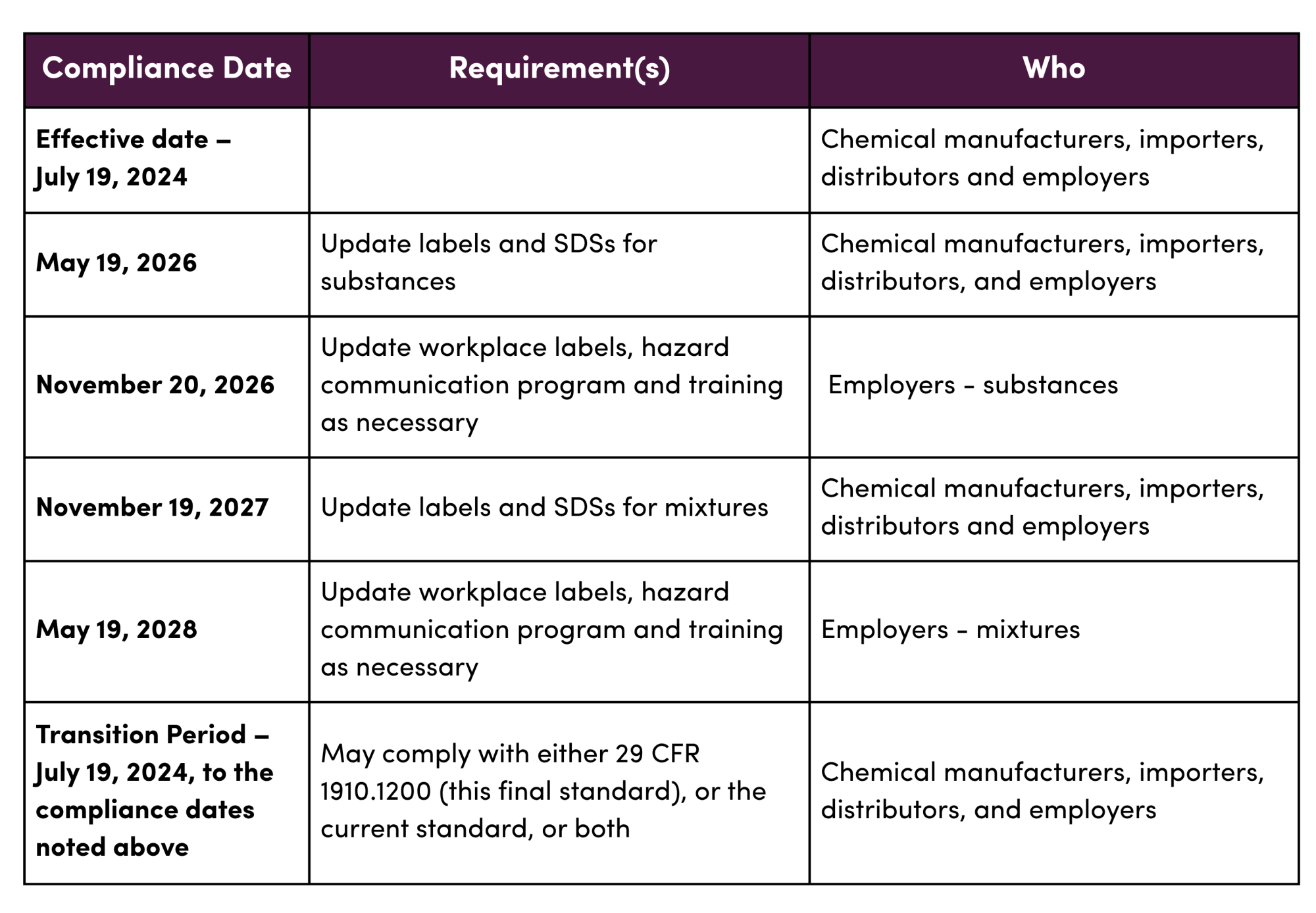
Source: OSHA, Questions & Answers for OSHA’s 2024 Update to the Hazard Communication Standard
The overall Haz Com Framework remains familiar and similar in scope, yet the practical implications of the 2024 updates are numerous and warrant careful attention. For example, changes to skin and eye hazard criteria may result in the reclassification of individual chemicals and mixtures that contain them at 1% or more. Classifications will need to look beyond intended use, to include reasonably anticipated uses or applications in the supply chain. These determinations remain grounded upon “known or reasonably ascertainable” information. Several new definitions, and changes to basic terms such as what constitutes an exposure, a hazardous chemical, and a physical hazard, should be carefully reviewed for their effect on scope and classification. Companies that work with compressed gases and pressurized hazards will need to pay close attention to the new requirements in these areas. Spray products may be affected by these same changes. There are important changes to the confidentiality provisions, including the need to use prescribed ranges to improve transparency and consistency. Table 2 summarizes the 2024 changes and highlights areas of the Haz Com Standard that will require attention in the coming months.
Table 2 – 2024 Haz Com Changes: 29 C.F.R. § 1910.1200 and Appendices
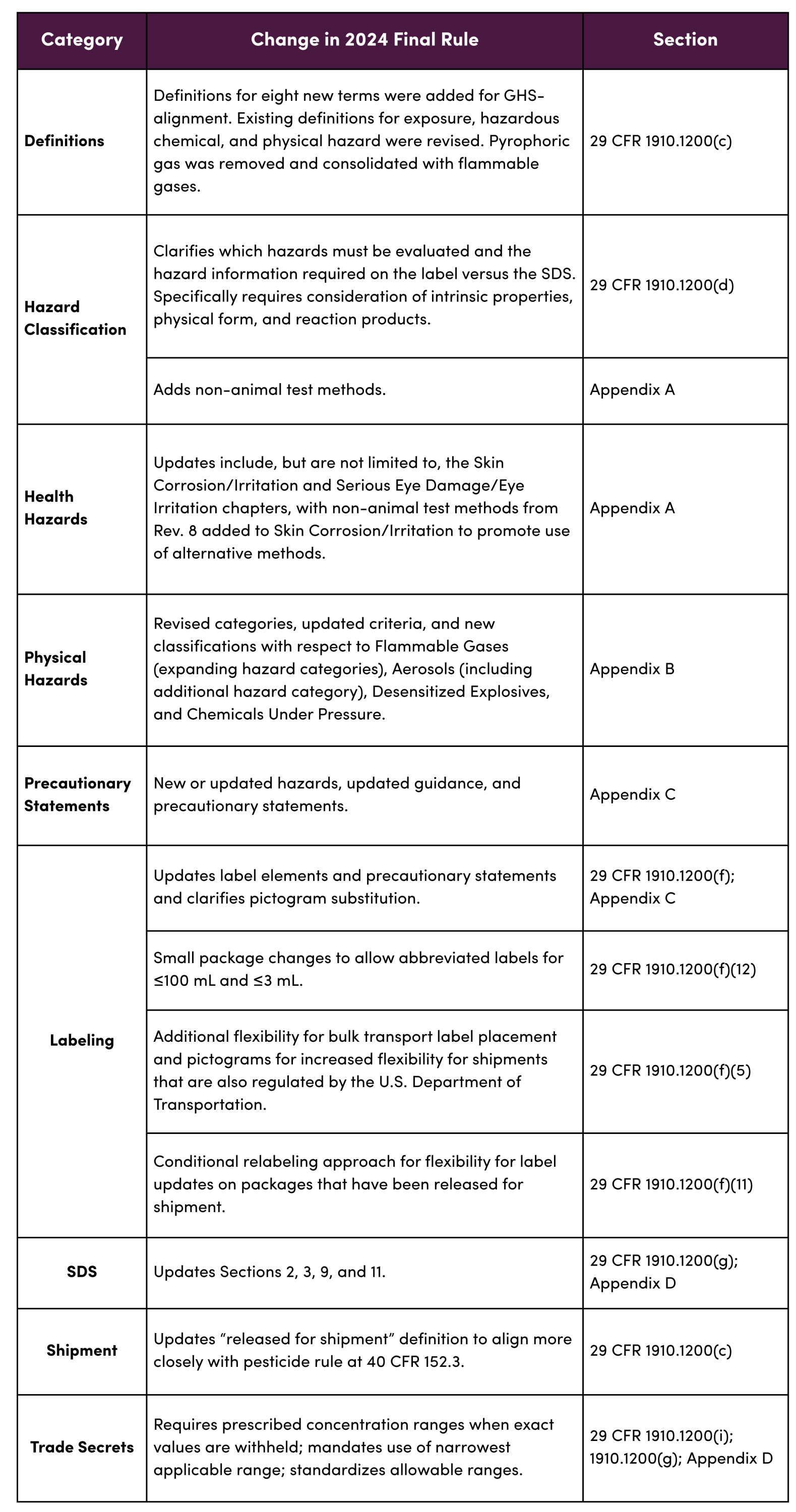
Source: Wiley Rein LLP
Failure to comply with these updates by the applicable deadlines may result in fines. Haz Com violations are one of the most common types of OSHA citations, (https://www.osha.gov/top10citedstandards), and penalties can be significant. It is not too early for downstream manufacturing companies to begin inventorying products and tracking receipt of updated supplier SDSs. With new SDSs in hand, companies will be able to assess how the revised hazard information affects their mixture classifications and plan to make corresponding updates to labels, written hazard communication programs, and employee training.
At Wiley, our experienced attorneys can help companies identify and review changes to SDSs and labels and respond to OSHA citations. While many companies now use vendors and software programs to prepare SDSs, reviewing finished SDSs and the information that is transferred to product labels requires careful attention to detail. Vendors are sure to become busy this year, so now is the time to start preparing to get your SDSs and labels updated.